The price of an HVAC air filter in South Africa comes down to five things: its grade, how it is built, its size, the paperwork that ships with it, and what it takes to get it to your site. That is why filters of similar face size sit at very different prices.
This guide covers filters for air handling units and commercial ventilation, not car air filters or the mesh filters in a split-unit aircon.
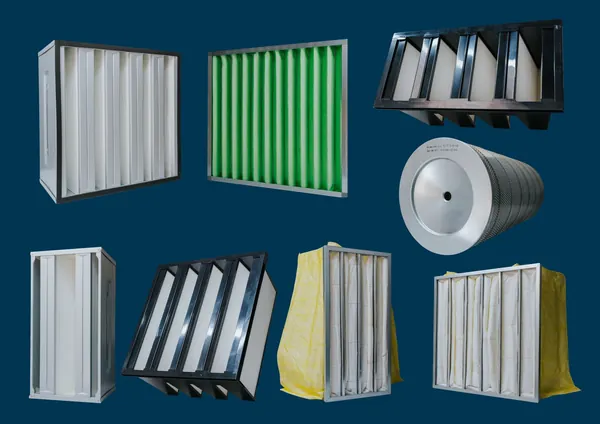
In our range at full size, the order from lowest to highest unit price is G4 panel, F9 pocket, F9 V-bank, then H13 and H14 HEPA. We print no price list here, because a printed price goes out of date. The current price per filter, including VAT, is on each product page:
- G4 panel filter prices
- F9 pocket filter prices by size
- F9 V-bank filter prices
- H13 HEPA price and H14 HEPA price
What Sets the Price of an HVAC Filter
- Grade. How fine the filter is, and the standard it is rated to: EN779 for G4 and F9, EN1822 for H13 and H14. (EN779 has been replaced in Europe by ISO 16890, but South African specs still name its grades.) Our air filter grades guide explains the system.
- Build. The media, how much of it the filter holds, and the frame that carries it.
- Size. The face (width × height) and the depth. Depth is a driver in its own right.
- Paperwork. A HEPA filter is tested and documented unit by unit, which a panel or pocket filter is not.
- Supply. In stock or made to order, single filter or full box, delivered or collected.
Why Each Filter Type Costs What It Does
| Filter (full size) | Grade | Media and frame | Depth, weight | Filters per box | Per-unit test certificate | Price order (1 = lowest) |
|---|---|---|---|---|---|---|
| G4 panel, 595×595×48mm | EN779 G4, ≥90% average arrestance | Non-woven synthetic, aluminium alloy frame | 48mm, 1,6 kg | 6 | No | 1 |
| F9 pocket, 595×595×330mm | EN779 F9, ≥95% at 0,4 µm | Moisture-resistant synthetic in 6 pockets, galvanised steel frame | 330mm, 1,7 kg | 9 | No | 2 |
| F9 pocket, 595×595×600mm | EN779 F9, ≥95% at 0,4 µm | The same, with deeper pockets | 600mm, 2,1 kg | 6 | No | 3 |
| F9 V-bank, 592×592×292mm | EN779 F9, ≥95% at 0,4 µm | Synthetic mini-pleat in V packs, ABS plastic frame | 292mm, 7,3 kg | 1 | No | 4 |
| H13 HEPA, 610×610×292mm | EN1822 H13, ≥99,95% at MPPS | Glass fibre, galvanised steel frame, EPDM gasket | 292mm, 19,9 kg | 1 | Yes, serial-numbered | 5 |
| H14 HEPA, 610×610×292mm | EN1822 H14, ≥99,995% at MPPS | Glass fibre, galvanised steel frame, EPDM gasket | 292mm, 19,9 kg | 1 | Yes, serial-numbered | 6 |
Specifications from the Airtech product pages and datasheets. Price order is the order of our online unit prices on 13 November 2026; check the product pages for current prices.
G4 panel filter price
We stock ten G4 panel sizes from 295×295mm to 595×595mm, and smaller sizes generally cost less.
The panel can be washed and refitted up to 6 times, which changes its cost per year. Wash it when the differential pressure reaches 200 to 250 Pa, let it dry fully before refitting, and replace it after the sixth wash, or sooner if the media or frame is damaged. See current G4 panel prices.
F9 pocket (bag) filter price
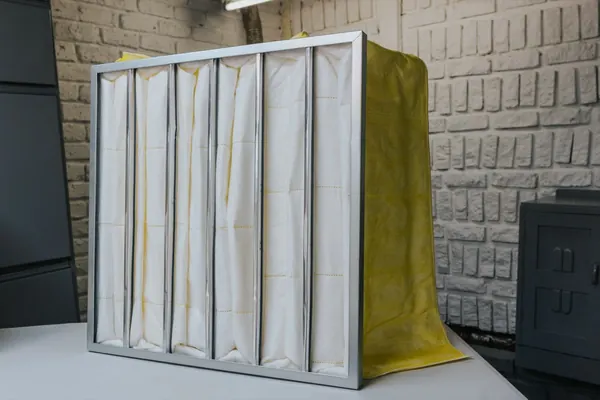
At the same face size, a 330mm F9 pocket, or bag, filter costs more than the panel. It is a finer grade and carries more media, formed into six pockets.
The 600mm depth costs more to buy and packs six to a box against nine. The 600mm starts at 105 Pa, against 225 Pa for the 330mm, both at 3 400 m³/h (±10%), and it needs 600mm of clear depth behind the bank. Neither depth is washable. Prices by size are on the pocket filter page, and the pocket filter guide covers the depth decision.
F9 V-bank filter price
The V-bank is the same F9 grade at a higher price: mini-pleat media in rigid V packs inside an ABS plastic frame, at 7,3 kg against 1,7 kg for the 330mm pocket.
It starts at 110 Pa (±10%) at 3 400 m³/h in 292mm of depth. What that saves depends on your fan, your airflow and how long the filter stays in. Check your filter section depth and specification, or call Nick, before you change format. The live V-bank price is on its page.
HEPA filter price: H13 and H14
HEPA carries the highest unit price in the range, and H14 costs more than H13 at both stocked sizes. Both grades are glass fibre media in a galvanised steel frame with an EPDM gasket, 19,9 kg at full size.
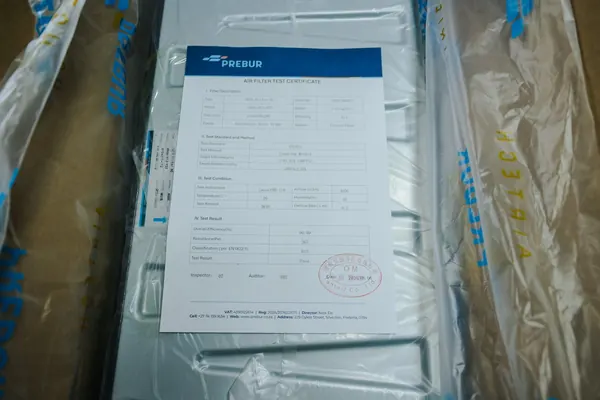
Every Airtech HEPA unit, H13 and H14 alike, is individually tested and ships with its own serial-numbered EN1822 test certificate, work a panel or pocket filter does not carry.
Your specification decides which grade you need: our HEPA grades guide sets out the difference. See the H13 HEPA price and the H14 HEPA price.
Size, Depth and Custom Dimensions
Smaller sizes generally cost less, but price does not scale with face area, so check each size on its product page.
Our range runs 48mm (panel), 292mm (V-bank and HEPA), and 330mm or 600mm (pocket) deep, so a quote that gives only the face size does not identify the filter.
Custom panel, pocket and V-bank sizes are made to order on a 7 to 10 day lead time and quoted individually. Non-standard HEPA dimensions are available on request.
Measure the filter, not the opening it sits in. On a new bank, holding frames and clips are separate items: frames for the 610mm module ship five to a pack, and clips are sold in packs of 10.
Purchase Price Versus Cost per Year
The purchase price is one of four cost lines. The others are the labour to change the filter, the fan energy used to push air through it, and disposal.
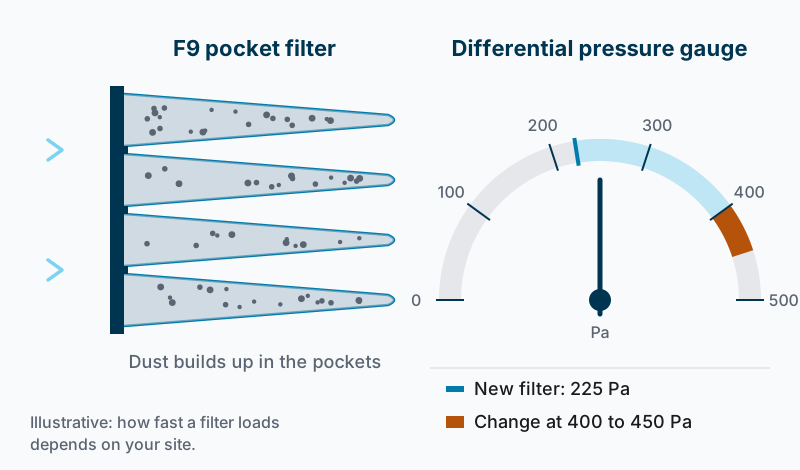
An F9 pocket filter (595×595×330mm, at 3 400 m³/h) climbs from its rated 225 Pa ±10% to the 400 to 450 Pa change band as it loads with dust; the shape of the climb and the loading time are illustrative, not measured.
| Cost line | What drives it | Where to find your number |
|---|---|---|
| Filters bought per year | How long your filters take to reach the change point, how well the pre-filter is kept up, and whether the G4 is washed | Your gauge readings and change records |
| Price per filter | Grade, build and size | The product page for each filter |
| Labour per change | Number of filters, access, and your own rate | Your own records |
| Fan energy | The filter’s average resistance over its life, your airflow, running hours and fan efficiency | Initial and final resistance on the product page; airflow and hours from your plant |
| Disposal | What your site pays to remove used filters | Your own records |
Filters per year
Change on the pressure reading, not on the calendar. The suggested change points on our datasheets are 200 to 250 Pa for the G4 panel, 400 to 450 Pa for F9 pocket and V-bank filters, and 500 to 600 Pa for H13 and H14. Where your system designer or validation protocol sets a limit, that limit applies.
Filters per year = filter positions × 12 ÷ the number of months your filters take to reach the change point on your gauge. Our air filter replacement intervals guide gives typical ranges by region, but your own readings are the better number.
A neglected pre-filter shortens the life of the filters behind it, so keeping the G4 up reduces what you spend on the stages behind it. The AHU filter stages guide explains how.
Fan energy
A filter’s resistance rises as it loads, and the fan has to work against it. On a fan that runs most of the year, the electricity used to push air through a filter over its life can exceed the filter’s purchase price, depending on your running hours, your fan and your tariff.
For scale, Eurovent’s 4/21 rating method (fourth edition, 2019) works out the filter’s share of fan energy, in kWh a year, as airflow in m³/s × average pressure drop in Pa × running hours ÷ (fan efficiency × 1 000). At its reference conditions (3 400 m³/h, which is 0,944 m³/s, held constant by a speed-controlled fan, 6 000 hours a year, a fan efficiency of 50%), 100 Pa of average filter resistance is roughly 1 130 kWh a year. Fewer running hours reduce that in proportion, and a more efficient fan reduces it too. Eurovent presents the figure as a laboratory indicator, and a real plant can differ significantly.
This applies where the fan is speed-controlled to hold airflow. On a fixed-speed fan, a loading filter mostly shows up as less air delivered, not as a matching rise in power. The formula also needs the average resistance over the filter’s life, which depends on your site, so we put no energy figure on any Airtech filter. If you do not know what your unit moves, start with the face velocity calculator.
The change point is itself a cost decision: changing earlier cuts fan energy and raises what you spend on filters and labour.
What to Check When You Compare Two Quotes
Two quotes are comparable only when they name the same grade, the same size including depth, and the same price basis.
| Item on the quote | What to check | Why it matters |
|---|---|---|
| Grade and standard | The same grade on both, with EN779 or EN1822 named | A different grade is a different filter. An ISO 16890 class cannot be matched one-to-one to an EN779 grade |
| Size | Width × height × depth in mm | A 330mm and a 600mm pocket share a face and differ in price |
| Media and pockets | Media type, and the pocket count on a pocket filter | It tells you how much media you are buying |
| Initial resistance | The figure, and the airflow it is quoted at | Without the airflow, two figures cannot be compared |
| Final resistance | The suggested change point | It sets how long the filter runs |
| Price basis | Per filter or per box; including or excluding VAT | Quotes on different bases are not comparable |
| Quantity | Filters per box and any minimum order | It changes the total on a small order |
| Delivery | Included or extra, and to which address | It is part of the delivered cost |
| Stock | In stock, or made or imported to order | It decides when you can fit the filter |
| Paperwork | A per-unit test certificate on HEPA | It goes into your validation file |
| Reuse | Washable or single use | It changes filters bought per year |
| Returns | What happens if the size is wrong | Custom sizes are often excluded |
Choosing the supplier is a separate question, covered in our guide to air filter suppliers in South Africa. Contractors pricing several sites will find more on the HVAC contractors page.
What Changes the Delivered Cost
The price on each product page is per filter including VAT, and the cart shows the VAT separately.
Delivery is not included in the product price. It is priced for your address and the parcels in your order, and you see it at checkout before you pay. Collection from Silverton, Pretoria is at no charge. See the delivery policy.
You can order a single filter or full boxes. Every parcel counts towards the delivery price.
Standard stock filters can be returned within 30 calendar days, unused and unopened, with free return collection. Custom sizes are excluded. The full conditions are in the returns policy.
Where to See Current HVAC Air Filter Prices in South Africa
- G4 panel filters: ten sizes, all 48mm deep
- F9 pocket filters: three sizes, 330mm and 600mm deep
- F9 V-bank filters: two sizes, 292mm deep
- H13 HEPA filters: two sizes
- H14 HEPA filters: two sizes
Standard sizes in stock at our Silverton warehouse. We deliver, or you can collect. Custom sizes, complete filter banks and volume orders get a written quote. The Airtech range is manufactured to EN779 and EN1822 standards in an ISO 9001 facility. If you came here for dust-collection filters, those are on the cartridge filters page.
Pricing a filter change? Call Nick Els on +27 74 159 1634 with the grade, size and quantity, or Get a Quote. Prebur has traded from Pretoria since 1989.
Frequently Asked Questions
How much does an HVAC air filter cost in South Africa?
It depends on the grade, the build and the size. In our range at full size, the order from lowest to highest unit price is G4 panel, F9 pocket, F9 V-bank, then H13 and H14 HEPA. The current price for each stocked size is shown per filter, including VAT, on its product page.
Why is a HEPA filter so much more expensive than a panel filter?
It is a different build with different paperwork. A full-size Airtech HEPA has glass fibre media in a galvanised steel frame with an EPDM gasket and weighs 19,9 kg; a full-size G4 panel weighs 1,6 kg. Every HEPA unit, H13 and H14 alike, is also individually tested and ships with its own serial-numbered EN1822 test certificate.
Can a filter with a higher price cost less per year?
Sometimes. A filter that starts at a lower resistance puts less load on a speed-controlled fan, and on some sites it also takes longer to reach the change point. Whether that outweighs the higher purchase price depends on your fan, your airflow and your running hours, so work it out on your own gauge readings.
Are your prices per filter or per box?
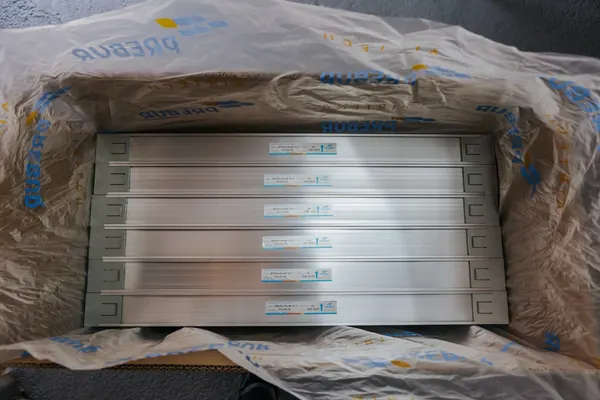
Per filter. Each product page shows the price per filter including VAT, and the cart shows the VAT separately. You can order a single filter or full boxes. A full box holds 6 G4 panels, 9 F9 pocket filters at 330mm deep or 6 at 600mm, and 1 V-bank or 1 HEPA filter, all at full size.
Is delivery included in the price?
No. Delivery is priced for your address and the parcels in your order, and you see the cost at checkout before you pay. Collection from our Silverton, Pretoria warehouse is at no charge.
Do these prices cover car air filters or home aircon filters?
No. This guide and our product pages cover filters for air handling units and commercial ventilation: G4 panels, F9 pocket and V-bank filters, and H13 and H14 HEPA. Car air filters and the mesh filters in a split-unit aircon are different products, and we do not supply them.
Need help choosing the right filter?
Speak to Nick Els for expert advice on filter selection, cross-referencing, and pricing for your facility.