Do I need H13 or H14? Both are HEPA, but there is a meaningful difference between them. If you are specifying filters for a cleanroom, hospital, or data centre, the grade you choose affects how many particles get through and whether you pass your next compliance audit.
This guide explains the difference in plain language, covers when each grade is appropriate, and helps you make the right call for your facility.
How HEPA Filters Are Tested (EN1822)
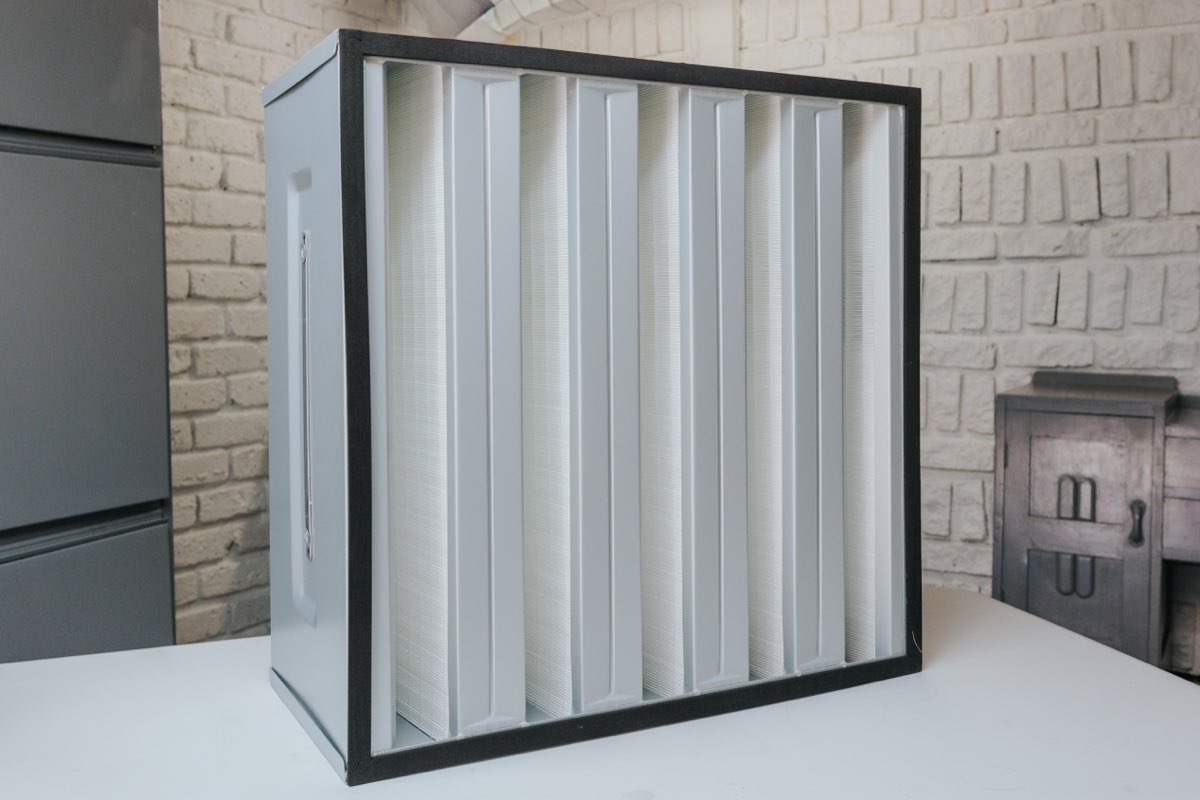
HEPA filters are tested at the particle size they find hardest to catch. This is called the Most Penetrating Particle Size (MPPS), typically between 0.1 and 0.3 micrometres. Particles larger than this get trapped by physical impact against the fibres. Particles smaller than this get trapped because they bounce around randomly and stick to the fibres. But at MPPS, neither mechanism works at full strength, so filtration efficiency is at its lowest.
The standard that defines all of this is EN1822 (current version EN1822:2019). When a filter passes at MPPS, you know it will perform even better against every other particle size.
The other important feature of EN1822 is individual unit testing: the standard requires each H13 and H14 filter to be tested on its own at the factory, not classified from a batch sample. On the Airtech range, the serial-numbered test certificate is supplied with every HEPA unit, H13 and H14 alike. Below HEPA, filters are batch-classified and supported by a CNAS laboratory test report for the grade instead.
H13 vs H14: What the Numbers Mean
In simple terms: H14 lets through ten times fewer particles than H13. Both are excellent filters, but that tenfold difference matters in high-stakes environments like pharmaceutical cleanrooms and operating theatres.
| Grade | Overall Efficiency at MPPS | Maximum Local Penetration | Certificate Supplied with Filter |
|---|---|---|---|
| H13 | ≥ 99.95% | ≤ 0.25% | Yes: individual serial-numbered EN1822 test certificate |
| H14 | ≥ 99.995% | ≤ 0.025% | Yes: individual serial-numbered EN1822 test certificate |
Overall efficiency is the average performance across the whole filter face.
Local penetration is the worst-case reading at any single point on the filter. This scan test catches pinholes, media defects, or seal failures that would let particles bypass an otherwise good filter.
When H13 Is the Right Choice
H13 is appropriate for applications where high-efficiency filtration is needed but the absolute highest grade is not mandated:
- Hospital general ventilation: critical care wards, oncology units, and bone marrow transplant areas typically specify H13 for supply air
- Data centre critical zones: ISO Class 8 environments can be achieved with H13 terminal filtration
- Pharmaceutical Grade C environments: where the process does not require Grade A cleanliness
- Electronics manufacturing: where particulate control matters but sterility is not required
- Research laboratories: BSL-2 exhaust filtration typically uses H13
When H14 Is Required
H14 is the minimum for the most demanding applications:
- Pharmaceutical Grade A cleanrooms: sterile manufacturing requires ISO Class 5 cleanliness, which means H14 terminal filtration
- Hospital operating theatres: infection control guidelines and accreditation standards require H14, particularly for orthopaedic implant surgery
- Sterile compounding pharmacies: hospital and commercial compounding facilities classified as ISO Class 5
- High-containment laboratory exhaust: exhaust air must pass through H14 before discharge to contain biological aerosols
The Individual Test Certificate
Every Airtech H14 HEPA filter supplied by Prebur comes with a serial-numbered EN1822 test certificate. The certificate records:
- Filter model and serial number: unique to the specific unit
- Overall efficiency at MPPS: measured against the H14 minimum of ≥99.995%
- Local penetration scan test results: confirming no point exceeds the ≤0.025% limit
- Test date and conditions: airflow rate and MPPS particle size
- EN1822 classification: standard version and grade
This certificate is the documentation your QA team or infection control officer needs. For pharmaceutical validation, it forms part of the Installation Qualification (IQ) package. For hospital HVAC records, it provides the evidence base for the service log.
Does South Africa Have Its Own HEPA Standard?
South Africa does not have a separate national HEPA filter standard. The applicable standard is EN1822, which is referenced by the regulatory frameworks that govern HEPA use in SA:
- SAHPRA aligns with EU GMP Annex 1, which requires HEPA terminal filtration for Grade A environments. EN1822 H14 is the accepted standard for meeting this requirement in South Africa.
- JCI-accredited South African hospitals typically specify H14 HEPA for operating theatres to meet infection control requirements.
- SANS 10173 specifies ventilation requirements for healthcare facilities, and engineers typically use EN1822 H13/H14 HEPA filtration to achieve the required cleanliness levels in critical areas.
Practical takeaway: When specifying HEPA for a South African project, write “EN1822:2019 H14” (or H13 where appropriate) and, for H14 terminal filtration, require the individual serial-numbered test certificate. This wording is unambiguous to contractors, accepted by SAHPRA auditors, and satisfies JCI and SANS requirements. Avoid specifying “HEPA” without a grade. The term on its own does not carry a defined efficiency threshold in South African regulation.
Practical Considerations
Physical size. The 610×610mm full-size format is standard for most South African AHU installations. The 305×610mm half-size fits AHU configurations where the full-size would require housing modification. Confirm your AHU terminal filter housing dimensions before ordering.
Storage. Store HEPA filters horizontally in their original packaging until installation. Vertical storage can stress the gasket. Avoid humid storage areas. Moisture can damage the glass fibre media.
Installation. H14 filters must be installed with the gasket correctly compressed against the AHU housing face. Bypass air through a failed gasket seal defeats the purpose of an H14 filter entirely. Check gasket condition and face seal on installation, and replace any filter that shows damage or defects before fitting.
Local availability. Prebur holds Airtech H14 HEPA filters in full-size and half-size formats in stock in Pretoria, with the individual serial-numbered EN1822 test certificate included on delivery.
Summary
- H13 and H14 are both HEPA grades under EN1822, but H14 has tenfold lower penetration than H13
- H13 is appropriate for hospital general ventilation, data centre critical zones, and ISO Class 8 applications
- H14 is required for GMP Grade A pharmaceutical cleanrooms, hospital operating theatres, and sterile compounding
- Every HEPA unit ships with an individual serial-numbered EN1822 test certificate, H13 and H14 alike. H14 is held in local stock in Pretoria; H13 is manufactured to order.
Need help selecting the right filter? Call Nick Els on +27 74 159 1634 or request a quote.
Frequently Asked Questions
Does South Africa have its own HEPA standard?
No. South Africa does not have a separate national HEPA filter standard. The applicable standard is EN1822:2019, which is referenced by SAHPRA (for pharmaceutical environments), JCI hospital accreditation, and SANS 10173 (ventilation for health facilities). When specifying HEPA for a South African project, write "EN1822:2019 H14" (or H13 where appropriate) and, for H14 terminal filters, require the individual serial-numbered test certificate.
What documents do I need for a SAHPRA GMP audit?
For HEPA filtration, you need the individual EN1822 test certificate for each installed filter (showing serial number, overall efficiency at MPPS, and local penetration scan results). These certificates form part of your Installation Qualification (IQ) package. Prebur supplies EN1822 certificates with every H14 HEPA order.
Can I use H13 instead of H14 in an operating theatre?
South African hospital accreditation and infection control guidelines require H14 for operating theatres, particularly for orthopaedic implant surgery and other high-risk procedures. H13 is appropriate for general hospital ventilation (critical care wards, oncology units) but does not meet the requirement for theatre terminal filtration. Always confirm the required grade with the specifying engineer.
Do HEPA filters come with individual test certificates?
Yes. Every Airtech HEPA filter, H13 and H14 alike, ships with its own serial-numbered EN1822 test certificate. This is not batch testing: the certificate confirms that your specific unit meets the grade's efficiency threshold and local penetration limit, and it is included with delivery at no additional cost. EN1822 requires each HEPA filter to be tested individually, which is why the certificate is per unit. H14 is held in local stock in Pretoria; H13 is manufactured to order from the factory.
How often should HEPA filters be replaced?
In pharmaceutical GMP Grade A cleanrooms, typical replacement intervals are 12 to 18 months, driven by differential pressure readings. Hospital operating theatres typically replace every 12 to 24 months. These intervals assume correct upstream filtration (G4 and F9 stages maintained on schedule). On the Highveld, where ambient dust loads are heavier, monitor differential pressure closely rather than relying on calendar intervals alone.
What pre-filtration do HEPA filters need?
HEPA filters require at least two upstream filtration stages: a G4 coarse pre-filter and an F9 fine secondary filter. Without proper pre-filtration, the HEPA loads with particles it was never designed to catch, and replacement intervals shorten dramatically. On the Highveld, where coal combustion and veldt fire smoke push ambient particulate levels high, maintaining the upstream G4 and F9 on schedule is critical to protecting HEPA service life. SANS 10173 specifies multi-stage filtration for health facility ventilation systems.
Need help choosing the right filter?
Speak to Nick Els for expert advice on filter selection, cross-referencing, and pricing for your facility.