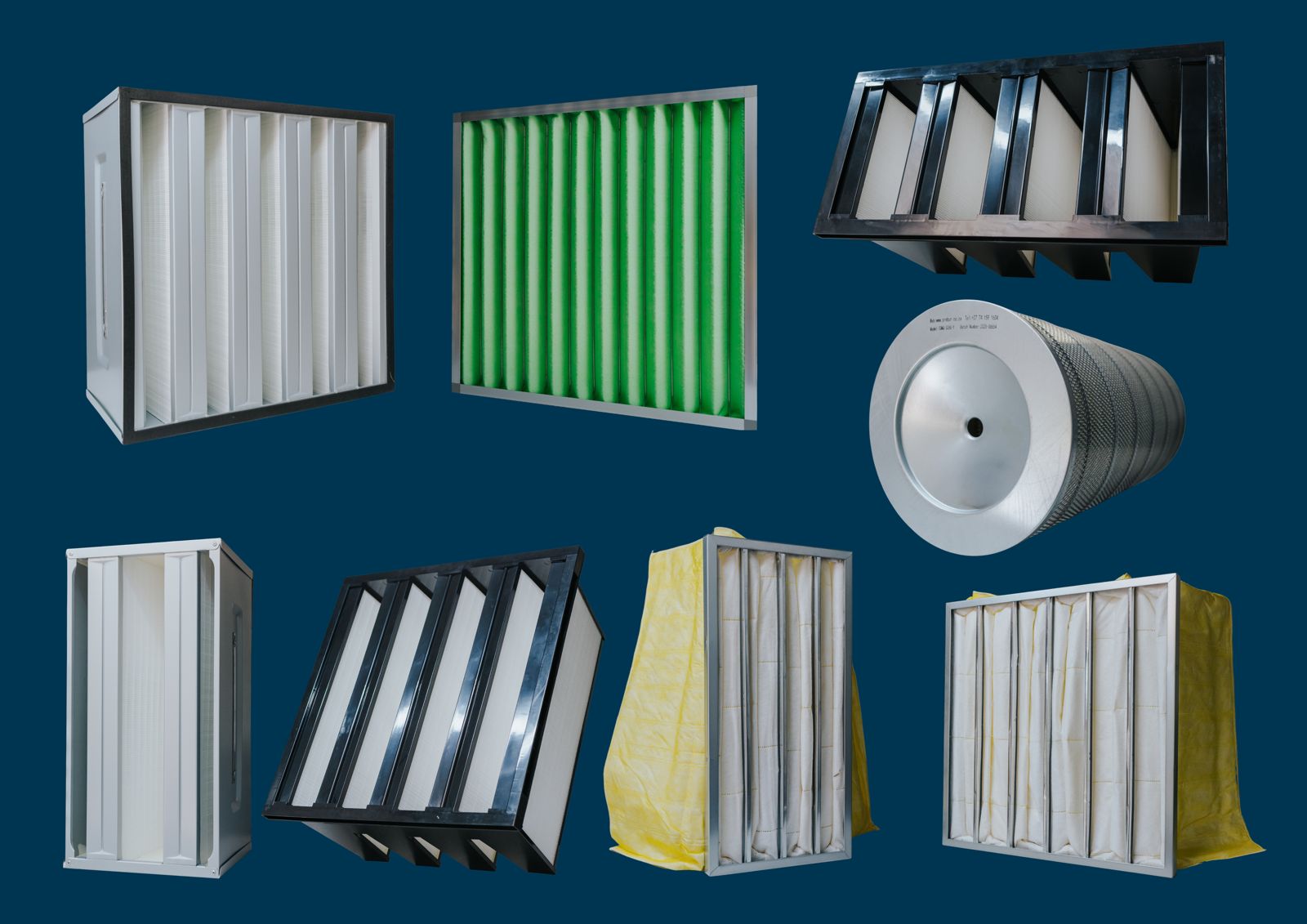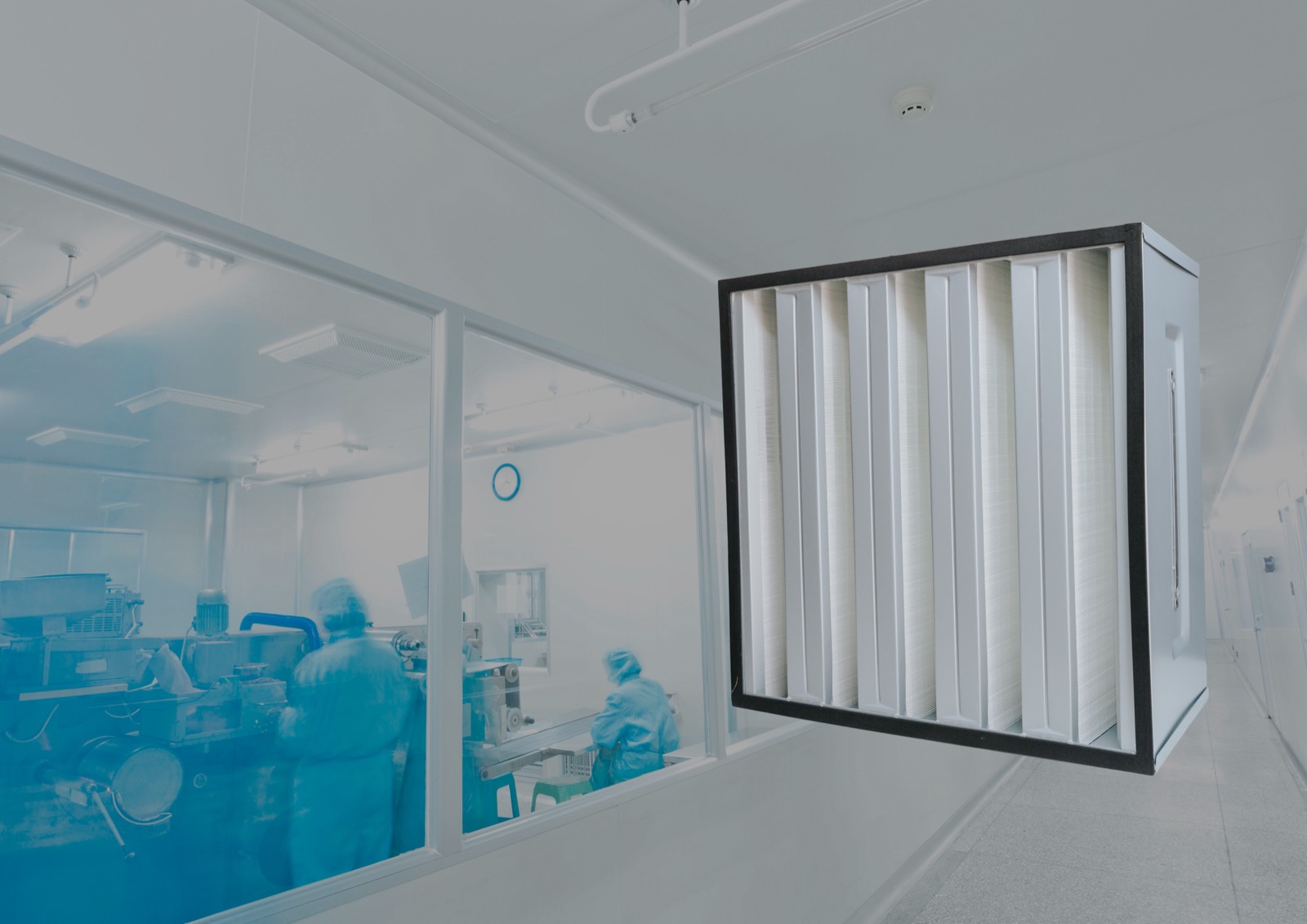
Facilities specifying HEPA filters in South Africa face two questions before anything else: which grade the application needs, and whether the units arrive with the documents an audit will ask for. HEPA is defined by EN1822, the European standard covering high-efficiency filters, with H13 and H14 the two grades used across local cleanrooms, hospitals, and pharmaceutical plants. Prebur holds Airtech H14 HEPA in stock in Pretoria, and every H14 unit ships with an individual serial-numbered EN1822 test certificate for the validation file.
This page covers the grade difference, where each is required, the certificate that separates H14 from lower grades, the sizes we hold locally, and how installed filters are verified on site.
HEPA Filters in South Africa: What You Need to Know
South African facilities specify HEPA against EN1822:2019, which defines high-efficiency filter classes from E10 through U17. HEPA covers H13 and H14. Both are rated at the Most Penetrating Particle Size (MPPS), the particle diameter a filter finds hardest to catch, so passing at MPPS means the filter performs better against every other size.
For a facilities or QA reader, three things matter in practice. The grade you specify (H13 or H14) follows the application and its cleanliness class. Both grades ship with a per-unit test certificate, which is the document your validation file needs. And lead time decides whether an air handling unit sits idle: importing to order can mean weeks of waiting, while a stocked filter despatches the same day.
Prebur is a direct importer and supplier of the range, not its manufacturer. The Airtech range is manufactured to EN1822 standards in an ISO 9001 facility, and we hold H14 HEPA in our Silverton, Pretoria warehouse. Owner-run since 1989, we confirm availability the same business day when you call.
Key Takeaways
- HEPA in South Africa is defined by EN1822: H13 (>=99.95% at MPPS) and H14 (>=99.995% at MPPS).
- H14 is required for GMP Grade A cleanrooms and operating theatres; H13 suits general hospital ventilation.
- Every HEPA unit, H13 and H14, ships with an individual serial-numbered EN1822 test certificate.
- Prebur holds two H14 sizes in Pretoria for same-day despatch, with free nationwide delivery.
H13 vs H14: Which Grade Do You Need?
The difference is a factor of ten at the filter’s weakest point. H13 removes at least 99.95% of particles at MPPS; H14 removes at least 99.995%, so roughly ten times fewer particles get through an H14. Both are genuine HEPA under EN1822, and that tenfold gap is what decides audit outcomes in sterile environments. The full derivation lives in our HEPA filter grades guide, which owns the MPPS maths.
| Grade | Efficiency at MPPS | Typical use | Per-unit certificate |
|---|---|---|---|
| H13 | >=99.95% | General hospital ventilation, supporting cleanrooms | Yes: serial-numbered EN1822 certificate |
| H14 | >=99.995% | GMP Grade A cleanrooms, operating theatres | Yes: serial-numbered EN1822 certificate |
The practical rule we give callers: if the space is a Grade A sterile zone or an operating theatre, specify H14. For a supporting cleanroom or general critical ventilation, H13 usually satisfies the requirement. When you are unsure, the specifying engineer’s grade call governs, and we supply against it either way. For the reasoning behind each threshold, the grades guide sets out the numbers in full.
Where Are HEPA Filters Required?
HEPA is the terminal filtration stage in any space where airborne particle counts are regulated, and ordinary comfort HVAC does not need it. Comfort ventilation tops out at an F7 to F9 fine filter. HEPA becomes mandatory once a room is classified under ISO 14644, the cleanroom standard, or falls under GMP or infection-control rules.
The applications we supply into most often are consistent across the sector:
- Pharmaceutical and GMP production: Grade A and B critical zones use H14 terminal filtration for sterile manufacturing. See our pharmaceutical filtration overview.
- Hospital critical areas: operating theatres and protective isolation rooms, where infection control drives the grade. Our healthcare filtration page covers the theatre and ward split.
- Classified cleanrooms: any space graded under ISO 14644 relies on terminal HEPA or ULPA to hold its particle count.
- Critical AHU final stage: the last filter before supply air enters a controlled space.
HEPA is a defined stage, specified against a cleanliness class and protected by upstream G4 and F9 filters that stop it clogging early. Where a room carries a class number, the HEPA is doing defined work, and the paperwork has to prove it. For how those classes are verified on site, our ISO 14644 cleanroom testing guide walks through the method.
The Test Certificate That Comes With Every HEPA Unit
Every Airtech HEPA unit we supply, H13 and H14 alike, ships with an individual serial-numbered EN1822 test certificate. The specific unit is tested at the factory, not classified from a batch sample, and the certificate records the serial number and the overall efficiency at MPPS against the grade minimum: >=99.95% for H13, >=99.995% for H14. It goes straight into your Installation Qualification package or HVAC service log.
This is a requirement of the standard rather than a service we add on top. EN1822 requires each HEPA filter to be individually tested and marked, which is precisely what separates HEPA from the coarse and fine grades below it. G4, F9, and other non-HEPA filters are batch-classified, so they carry a grade-level CNAS laboratory test report instead of a per-unit certificate. If you are offered an individual certificate on a G4 or F9, ask what the document actually is.
For a GMP or hospital audit, that certificate is the evidence expected against each installed terminal filter, which is why we lead with it. The filter and its paperwork arrive together, at no extra cost, ready for the validation file. The HEPA product page lists what the certificate contains.
Standard HEPA Sizes and Local Stock
We hold two Airtech H14 HEPA sizes in Silverton, Pretoria, both the standard AHU terminal formats South African facilities run. The full-size 610x610x292mm unit is rated for 3400 m3/h at 290 Pa initial resistance. The half-size 305x610x292mm unit is rated for 1700 m3/h at 300 Pa. Both ship with the individual serial-numbered EN1822 certificate.
| Size (mm) | Rated airflow | Initial resistance | Grade | Stock |
|---|---|---|---|---|
| 610 x 610 x 292 | 3400 m3/h | 290 Pa | H14 | In stock, Pretoria |
| 305 x 610 x 292 | 1700 m3/h | 300 Pa | H14 | In stock, Pretoria |
The half-size format fits AHU configurations where a full-size unit would need housing modification, so confirm your terminal housing dimensions before ordering. Both units start at roughly 290 to 300 Pa and are typically replaced once resistance climbs to about 500 to 600 Pa, so track differential pressure as the trigger. In-stock standard sizes despatch the same day, and free nationwide delivery applies to online orders. Non-standard dimensions are manufactured to order on a 7 to 10 day lead time, with availability confirmed the same business day when you call Nick on +27 74 159 1634.
Stock in Pretoria changes the downtime calculation on an AHU. A filter held on the shelf despatches the same day, where a filter imported to order can leave the unit offline for weeks. You can browse and buy the H14 HEPA range online, or request a quote for a custom size.
How Are Installed HEPA Filters Tested?
A HEPA filter only performs if the housing seals and the media is leak-free, so the factory certificate is one half of the picture and the installed test is the other. Once fitted, an H14 is verified on site by an aerosol scan that checks for pinholes, media defects, and gasket bypass. This is a different check from the EN1822 factory efficiency test: the factory certificate qualifies the media, and the on-site scan qualifies the installation and its seal. Our ISO 14644 cleanroom testing guide covers the scan procedure and pass criteria in full, and our cleanroom testing service in South Africa sets out how to book an on-site test.
Prebur offers this as a service. Our on-site air testing verifies installed HEPA integrity, air quality, and airflow, with Grant Lundie as our technical partner. Reports are issued in accordance with the relevant ISO standard methodology. When a test finds a filter that has failed its seal or scan, the replacement is already in stock in Pretoria, so one supplier covers the verification and the filter.
For a South African project, specify the grade explicitly, “EN1822:2019 H14” or H13 where appropriate, because “HEPA” alone carries no defined efficiency threshold. For H14 terminal filters, require the individual serial-numbered test certificate in the same line. That wording is unambiguous to contractors and gives an auditor the exact evidence to check against each installed filter.
Prebur supplies the whole airflow chain from one Pretoria warehouse: G4 and F9 pre-filters that protect the HEPA, the H14 HEPA itself, and the air testing that verifies it in place. We are a direct importer, owner-run since 1989. When you call, you speak to an owner, not a call centre, and availability is confirmed the same business day.
To source H14 HEPA with certificates included, view the HEPA product page or call Nick Els on +27 74 159 1634. For a wider view of local filter supply, see our air filter suppliers in South Africa guide.
Frequently Asked Questions
What is a HEPA filter?
A HEPA filter is a high-efficiency air filter classified under EN1822, the European standard for HEPA and ULPA filtration. The two grades used in South African facilities are H13 (at least 99.95% efficiency at the Most Penetrating Particle Size) and H14 (at least 99.995%). They are the final filtration stage in cleanrooms, operating theatres, and pharmaceutical production.
What is the difference between H13 and H14 HEPA filters?
Both are HEPA grades under EN1822. H13 removes at least 99.95% of particles at the Most Penetrating Particle Size; H14 removes at least 99.995%, roughly ten times fewer particles getting through. H13 suits general hospital ventilation and supporting cleanrooms. H14 is required for GMP Grade A cleanrooms and operating theatres.
Do your HEPA filters come with a test certificate?
Yes. Every Airtech HEPA unit we supply, H13 and H14 alike, ships with an individual serial-numbered EN1822 test certificate for your validation file, at no extra cost. EN1822 requires each HEPA filter to be tested individually at the factory rather than classified from a batch sample, so the certificate belongs to your specific unit. Certificates are a HEPA feature: they are not supplied with G4, F9, or other non-HEPA grades, which carry grade-level CNAS laboratory test reports instead.
What HEPA filter sizes do you stock in South Africa?
We hold two Airtech H14 sizes in Silverton, Pretoria: 610x610x292mm (3400 m3/h, 290 Pa initial resistance) and 305x610x292mm (1700 m3/h, 300 Pa). Both despatch same day when in stock. Non-standard dimensions are manufactured to order on a 7 to 10 day lead time.
Do you deliver HEPA filters nationwide?
Yes. Free nationwide delivery applies to online orders across South Africa. In-stock standard sizes despatch the same day from our Silverton, Pretoria warehouse. For custom dimensions, availability is confirmed the same business day and the filter is manufactured on a 7 to 10 day lead time.
Can you test HEPA filters after installation?
Yes. Prebur offers an on-site air testing service that verifies installed HEPA filters using an aerosol scan under ISO 14644-3 methodology. Grant Lundie is our technical partner. Reports are issued in accordance with the relevant ISO standard methodology. If a filter fails, the replacement is on our shelf in Pretoria.
Need help choosing the right filter?
Speak to Nick Els for expert advice on filter selection, cross-referencing, and pricing for your facility.