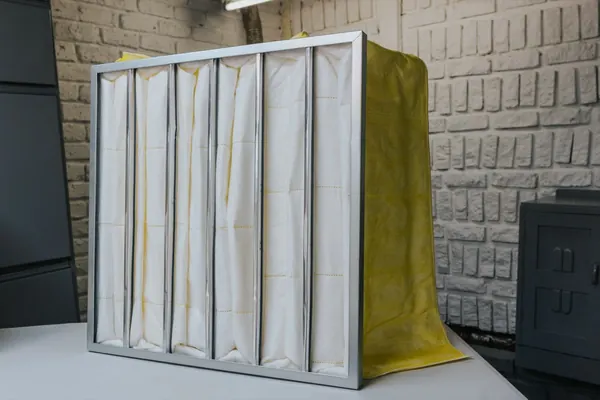
A pocket filter is the fine-filtration stage in an air handling unit: a row of fabric pockets fixed to a metal header frame, sitting behind the panel pre-filter. Many specs and maintenance sheets call the same thing a bag filter. This guide covers how to measure one, which depth to choose, how to fit it, when to change it, and when a rigid V-bank is the better buy. The figures come from the three F9 pocket filters we hold in stock in Pretoria.
Pocket Filter or Bag Filter: Same Thing, With One Exception
A bag filter in an HVAC system and a pocket filter are the same product, and our own datasheet uses both names. Outside HVAC, “bag filter” also describes the long fabric bags in an industrial dust collector (a baghouse) and the bags that strain liquids in a process line. Neither belongs in an air handling unit.
| Name | Where it is used | What it looks like | Where to go next |
|---|---|---|---|
| HVAC pocket (bag) filter | Air handling units, as the fine filter stage | A row of fabric pockets on a metal header frame | F9 pocket filters |
| Dust-collector filter bag | Industrial dust collectors capturing process dust | Long cylindrical fabric bags, which can be several metres long. Some collectors use cartridges instead | Cartridge filters |
| Liquid filter bag | Process lines straining water, paints and chemicals | A bag inside a housing, with the liquid flowing from the inside of the bag outwards | We do not supply these |
From here on, “bag filter” means the pocket air filter in an AHU.
Where a Pocket Filter Sits in an AHU
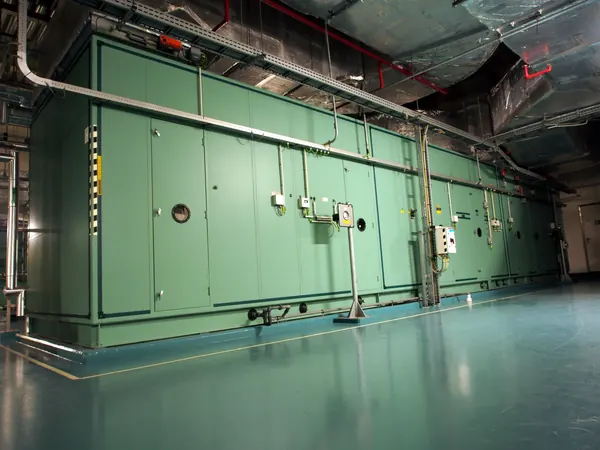
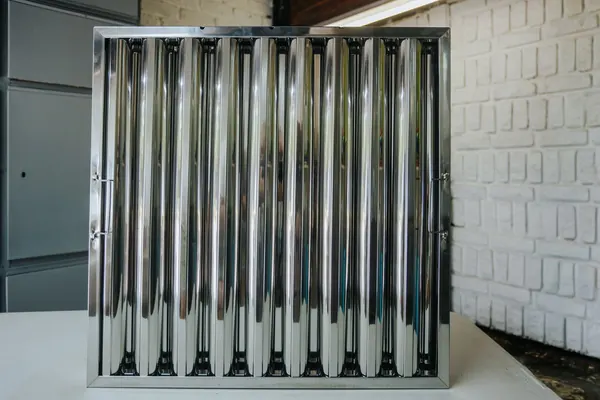
The pocket filter is the second stage in the filter bank, often called the secondary filter or fine filter. It sits behind the G4 panel filter and, where a unit has one, ahead of the HEPA stage. The panel pre filter takes most of the coarse dust first, so the pockets carry mainly the fine load they are made for. Let the panel go too long and the pocket filter loads faster.
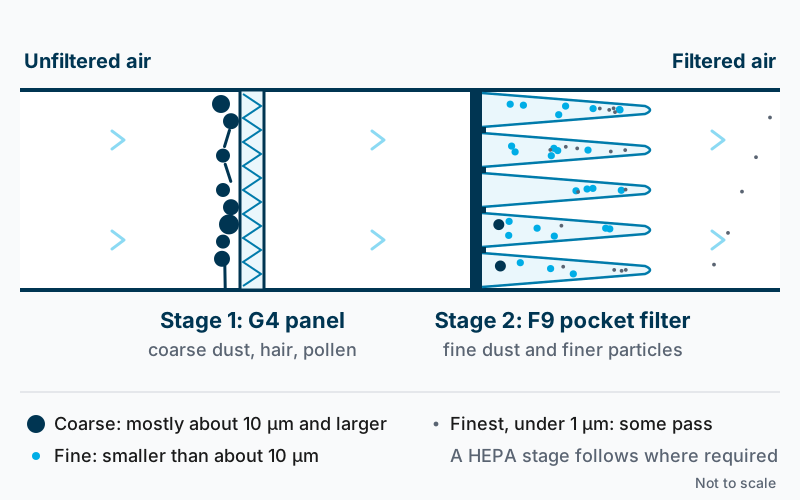
Air passes the G4 panel first, which holds most of the coarse dust, and then the F9 pocket filter, which takes most of the fine dust that gets past it.
Our AHU filter stages guide walks through the whole bank.
How a Pocket Filter Is Built
Header frame
The header is the metal frame at the front: galvanised steel on the Airtech filter. It seats in the holding frame, and its face is the dimension you order by.
Pockets and media
Behind the header, the media is formed into pockets, held open by aluminium supports. Pockets put more media behind the same face than a panel filter can hold, and more media area means lower resistance at the same airflow. Deeper pockets and more pockets both add media area, which is why a replacement order needs more than the face size.
The synthetic media does not absorb moisture the way paper-based media can, so it copes with humid air. It is not made for wet duty: replace a pocket filter that has been soaked.
How to Measure a Pocket Filter for Replacement
Switch the unit off and isolate it under your site procedure, pull one filter from the bank, and take four details off the filter itself.
- Measure the face of the header frame, width × height in mm, width first. Our half-size filter is 295 wide × 595 high.
- Measure the pocket depth, from the back of the header to the tip of the pockets. Our stocked depths are 330mm and 600mm.
- Count the pockets: 6 on our 595 wide filter, 4 on the 295 wide.
- Read the grade off the label or the spec. Ours are F9.
If you plan to change depth, also check the clear space behind the bank before you order.

Do not order from the size of the opening. A standard holding frame is a 610×610mm module, while the filter face that fits it is nominally 595×595mm. Header depth and seal type also affect the fit, so if your frames are another make, call Nick with the measurements. We stock holding frames and clips for the 610mm module.
Pocket Filter Sizes We Hold in Stock
We hold three F9 sizes. Standard sizes in stock at our Silverton warehouse. We deliver, or you can collect.
| Size (W×H×D) | Pockets | Rated airflow | Initial resistance | Weight | Pcs/carton |
|---|---|---|---|---|---|
| 595×595×330mm | 6 | 3 400 m³/h | 225 Pa ±10% | 1,7 kg | 9 |
| 295×595×330mm | 4 | 1 700 m³/h | 185 Pa ±10% | 1,15 kg | 16 |
| 595×595×600mm | 6 | 3 400 m³/h | 105 Pa ±10% | 2,1 kg | 6 |
You can buy a single filter or a full box. Current prices are on the pocket filter product page, with delivery quoted live for your address at checkout. Custom dimensions are on a 7 to 10 day lead time.
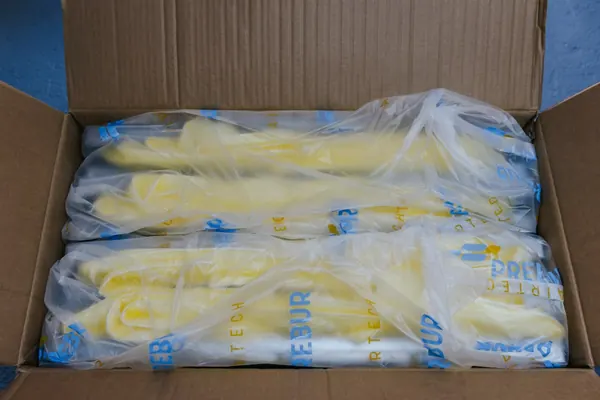
If you buy by the box, keep the filters in their wrapping and store them dry until you fit them. Contractors looking after several sites will find more on our HVAC contractors page.
Your bag filter sizes may not be in the table. Other makes come in other depths and pocket counts. Call Nick on +27 74 159 1634 with your measurements and he will tell you whether we can help.
330mm or 600mm: What Pocket Depth Changes
At the rated 3 400 m³/h, the 600mm filter starts at 105 Pa against 225 Pa for the 330mm (each ±10%), on the same header face and at the same F9 grade. Those are the rated figures. The datasheet’s resistance curves give test readings at other airflows.
| Airflow (m³/h) | 330mm pocket (Pa) | 600mm pocket (Pa) |
|---|---|---|
| 1 500 | 95 | 45 |
| 2 000 | 125 | 60 |
| 2 500 | 160 | 75 |
| 3 000 | 195 | 92 |
| 3 400 | 222 | 106 |
| 4 000 | 266 | 130 |
| 4 500 | 305 | 150 |
| 5 000 | 345 | 170 |
Initial resistance test readings from the Airtech pocket filter datasheet curves: 595×595mm, 6-pocket, F9. At 3 400 m³/h the curves read 222 and 106 Pa, inside the ±10% tolerance on the rated 225 and 105 Pa.
A filter that starts lower has further to climb before it reaches the change point. Filter resistance is also a significant part of the pressure the fan has to overcome, so a lower starting figure means less fan work, but only where the fan speed is controlled. Both depend on your unit and your site, so we put no percentage on either.
The trade-off: the 600mm filter needs 600mm of clear depth, packs 6 to a carton against 9, and weighs 2,1 kg against 1,7 kg.
The half size is rated at 1 700 m³/h, where it reads 185 Pa. At 3 400 m³/h its datasheet curve reads 415 Pa, already inside the change range, so do not ask a half-size filter to carry full-size airflow. If you do not know what your unit moves, start with the face velocity calculator.
Pocket Count: 4, 6, 8 or More
More pockets on the same header means more media. Pocket count, depth and grade together set the resistance and how much dust the filter holds, so compare all three and not the count alone.
We stock 6 pockets on the full-size header and 4 on the half size. If the filter in your unit has a different count, do not assume ours is a like-for-like swap. Call Nick with the header size, depth and pocket count.
Which Grade: F9 and the Rest of the Fine Range
The Airtech pocket filter is manufactured to EN779 and performance rated to EN779 F9: an average efficiency of 95% or more at 0,4 µm under EN779 test conditions.
Pocket filters are made across the fine range, and your spec may name another grade. Under EN779:2012, F7 is 80 to 90% average efficiency at the same particle size and F8 is 90 to 95%. A spec that says F5 or F6 is using the older names for what the 2012 standard calls M5 and M6. EN779 has since been superseded by ISO 16890, but South African specs still name the EN779 grades: our air filter grades guide explains the system, and EN779 vs ISO 16890 covers the change.
We do not hold an F7 bag filter or any other pocket grade in stock. If your spec calls for one, call Nick on +27 74 159 1634.
Per-unit test certificates are supplied with HEPA grades (H13 and H14), not with F9.
Fitting a Pocket Filter Correctly
Air that leaks past a badly seated header is unfiltered, so most of the fitting job is about the seal.
- Switch the unit off and isolate it under your site procedure before you open the filter section.
- Unwrap each filter only when you are ready to fit it, and do not fit a damaged one.
- Handle the filter by the header frame, not by the media.
- Fit it with the pockets standing vertically, as is standard practice.
- Seat the header squarely against the foam gasket on the holding frame and fasten the spring clips. Check that no pocket is trapped between the header and the frame.
- Look around the whole bank before you close up, and do not accept any visible gap.
If the bank has no differential pressure gauge across it, have one fitted and checked by a competent person. If a header will not sit flat in your frame, stop and call Nick with the frame dimensions.
When to Change a Pocket Filter
Change a pocket filter when the differential pressure across it reaches 400 to 450 Pa. That is the supplier’s suggested final resistance, and it lines up with EN779:2012, which tested fine filters to a final pressure drop of 450 Pa.
Change it sooner if it is damaged, has been soaked, or smells or shows growth. Some sites also set a hygiene time limit; if that comes first, change on the time limit. The Airtech pocket filter is not washable.
As a rough calendar guide, a 330mm F9 pocket on the Highveld is normally changed every 6 to 8 months, with the G4 kept up. That is a typical figure from our customers’ sites and yours will differ, so let the gauge decide. Our filter replacement intervals guide covers the other stages.
If you find dust on the clean side of the bank, check the seating and the gaskets before you blame the filter. To put a yearly figure on your schedule, use the replacement cost estimator.
Pocket Filter or V-Bank: Which One for Your Unit
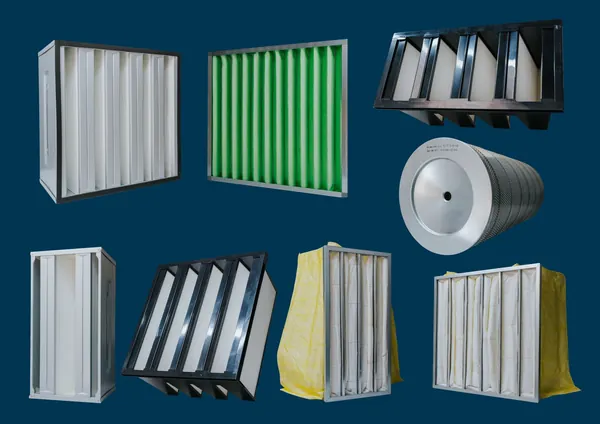
Both do the same F9 job, and the choice comes down to the depth you have. A V-bank filter is mini-pleat media in a rigid ABS frame: a large media area in a short depth.
| Format | Size (W×H×D) | Initial resistance at 3 400 m³/h | Weight | Pcs/carton | Best fit |
|---|---|---|---|---|---|
| F9 pocket, 330mm | 595×595×330mm | 225 Pa ±10% | 1,7 kg | 9 | Standard filter section, lowest unit cost |
| F9 pocket, 600mm | 595×595×600mm | 105 Pa ±10% | 2,1 kg | 6 | Section with 600mm clear, low starting resistance |
| F9 V-bank | 592×592×292mm | 110 Pa ±10% | 7,3 kg | 1 | Short section, low starting resistance |
Against the 330mm pocket, the V-bank starts at about half the resistance in less depth. Against the 600mm pocket it is close: at rated airflow the two start at about the same figure. Up to about 3 000 m³/h the V-bank reads slightly lower (52 Pa against 60 Pa at 2 000 m³/h). From there up, the 600mm pocket is lower (130 Pa against 140 Pa at 4 000 m³/h). With a ±10% tolerance on both, treat the two as equivalent on resistance and choose on depth, weight and cost.
The V-bank costs more per unit, weighs 7,3 kg and ships one to a carton.
Both formats are made for the 610mm holding-frame module, and a V-bank needs a section at least 292mm deep. Its rigid frame seats differently from a pocket header and it weighs 7,3 kg, so confirm the frame make, seal and dimensions with Nick before you swap.
Replacing pocket filters? Call Nick Els on +27 74 159 1634 with the header size, depth and pocket count, or Get a Quote. Prebur has traded from Pretoria since 1989, and the pocket filter is one part of the full Airtech range.
Frequently Asked Questions
Is a bag filter the same as a pocket filter?
In an HVAC system, yes: they are two names for the same filter, a row of fabric pockets on a metal header frame. Outside HVAC the name also covers the long fabric bags in an industrial dust collector and the bags that strain liquids in a process line. Those are different products. For dust collection, see our cartridge filters page.
How do I work out what size pocket filter I need?
Measure the filter, not the opening it sits in. You need four things: the header frame face (width × height in mm, width first), the pocket depth from the back of the header to the pocket tip, the number of pockets, and the grade on the label. Check those against our three stocked F9 sizes, or call Nick on +27 74 159 1634.
Can I fit a 600mm pocket filter where a 330mm one was?
Only if the filter section has the clear depth behind the bank for a 600mm pocket. The header face is the same 595×595mm. The gain is a lower starting resistance: 105 Pa against 225 Pa at 3 400 m³/h, each ±10%. The 600mm filter also packs 6 to a carton against 9, so allow for the storage space.
Which way round should the pockets hang?
Vertically, as is standard practice. If your filter bank only accepts the filter another way round, call Nick on +27 74 159 1634 before you fit it, and have the header size and the frame size to hand.
Can pocket filters be washed or vacuumed and reused?
No. The Airtech F9 pocket filter is not washable. Replace it when the differential pressure across it reaches 400 to 450 Pa, and sooner if it is damaged, has been soaked, or smells or shows growth. A G4 panel pre-filter left in too long makes the pocket filter load faster, so change the panel on time.
When is a V-bank a better choice than a pocket filter?
When the filter section is short and you want a low starting resistance. Our F9 V-bank is 292mm deep and starts at 110 Pa at 3 400 m³/h, against 225 Pa for the 330mm pocket. Where you have 600mm of clear depth, the 600mm pocket starts at about the same resistance, weighs less and costs less per unit.
Need help choosing the right filter?
Speak to Nick Els for expert advice on filter selection, cross-referencing, and pricing for your facility.