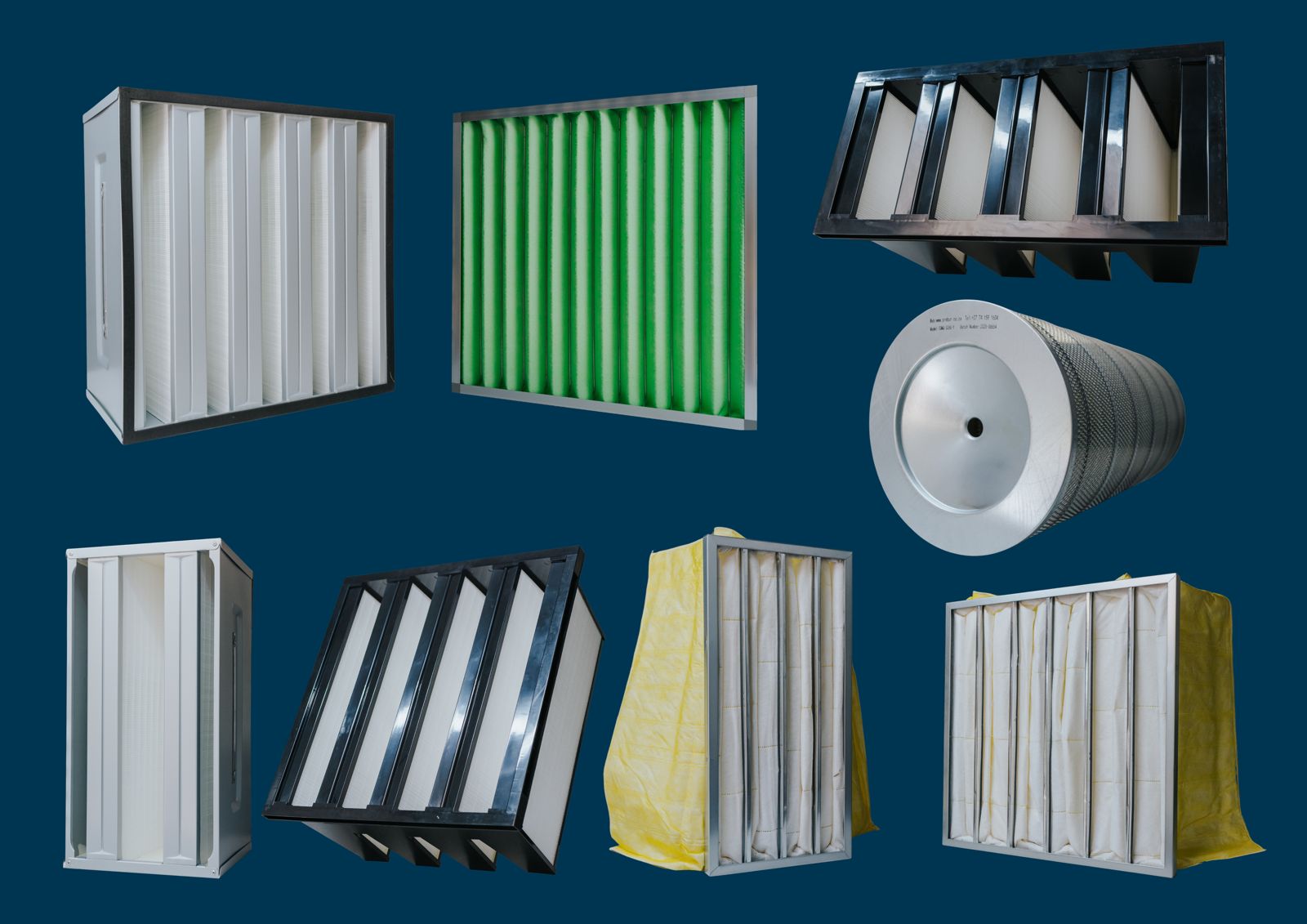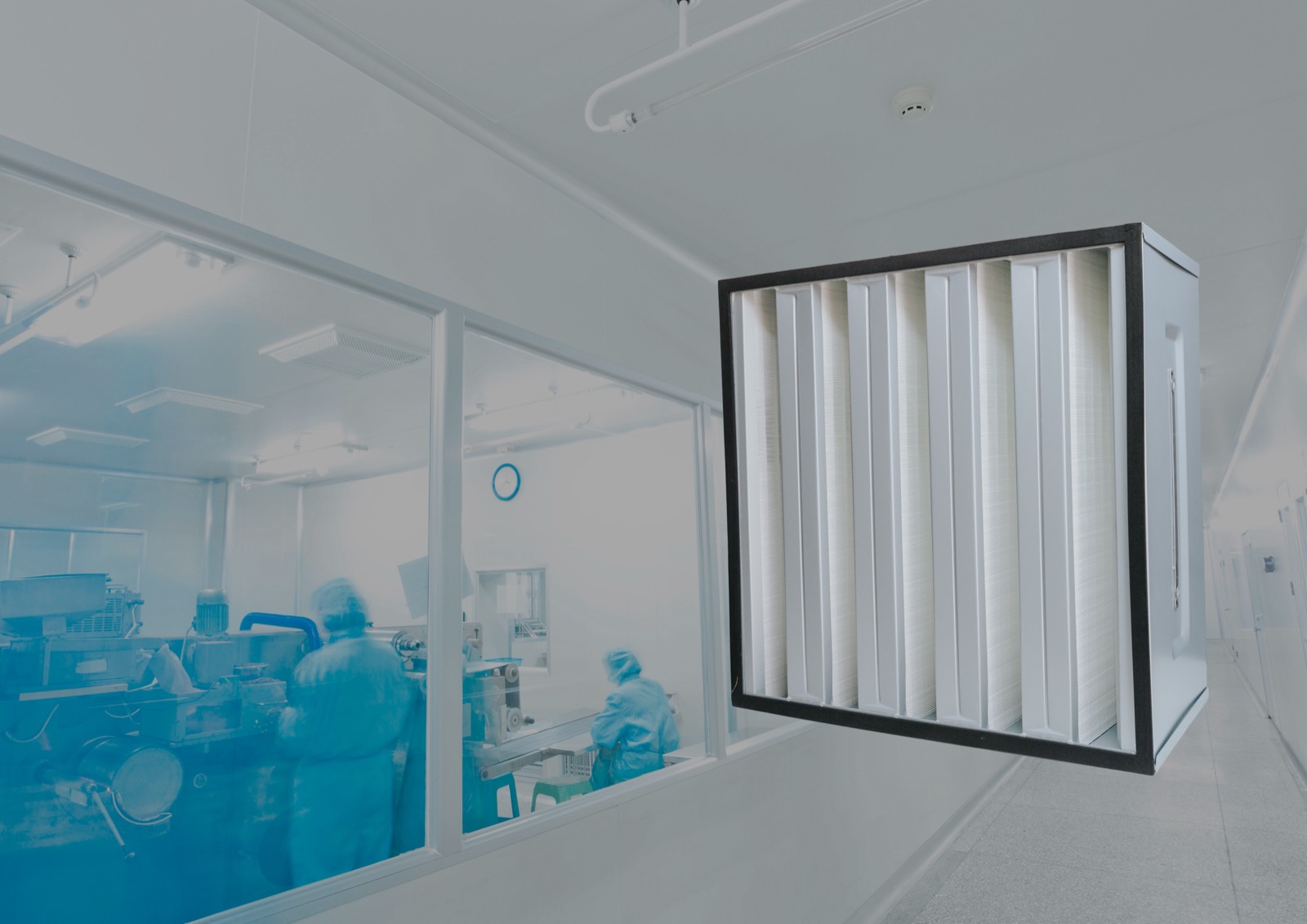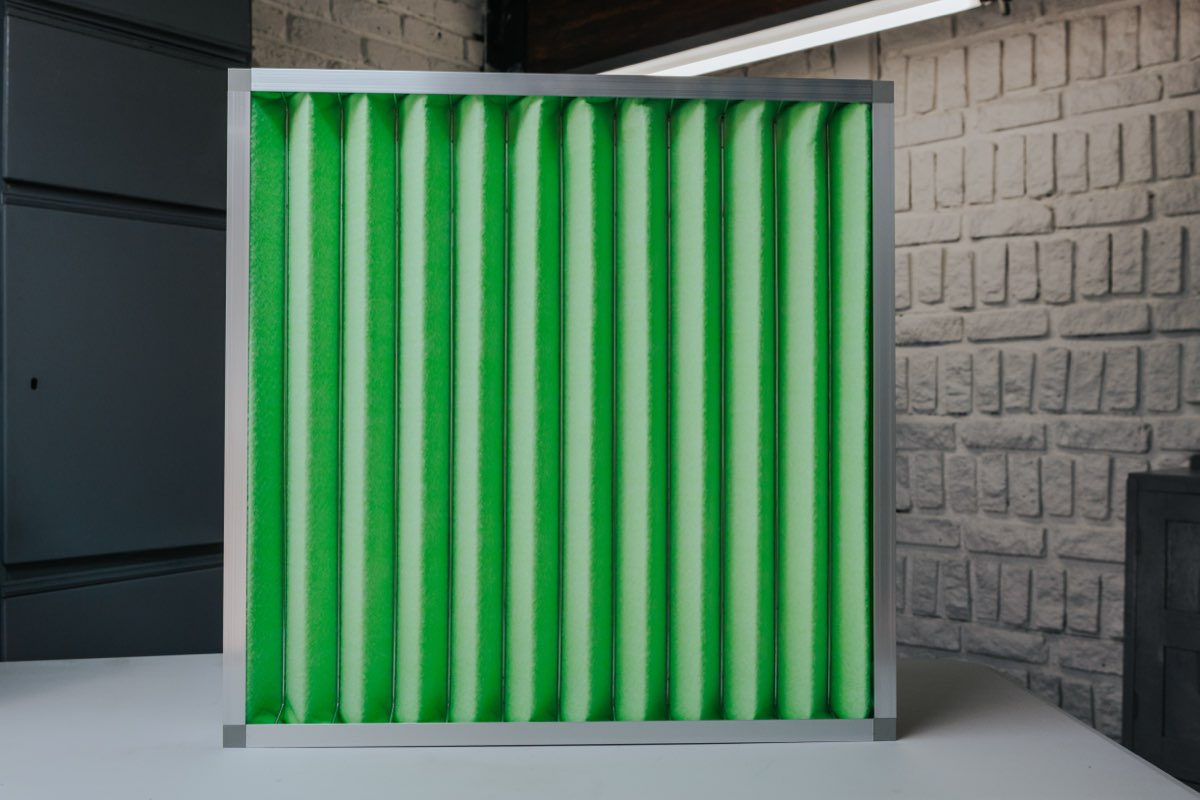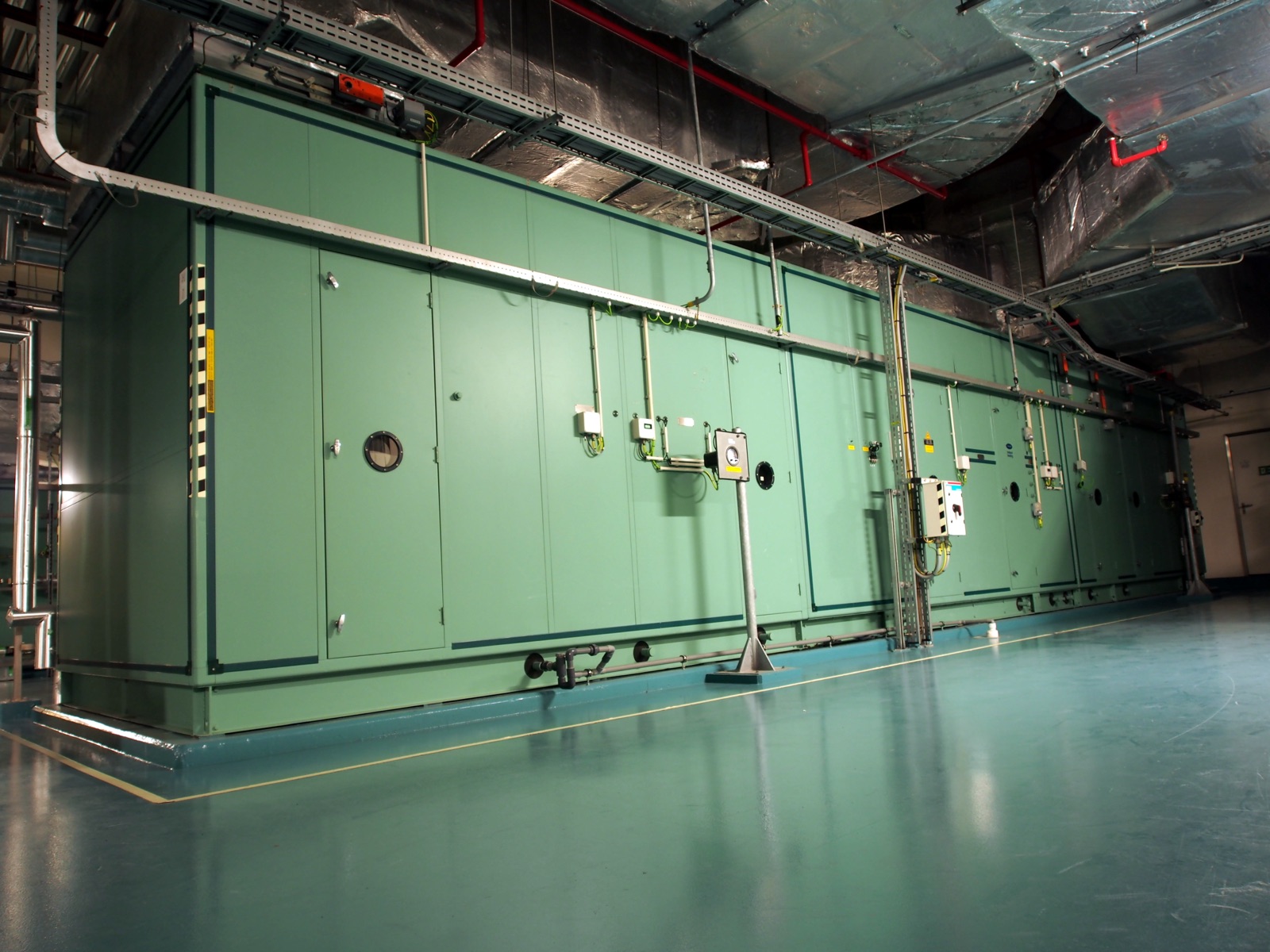
A typical commercial air handling unit runs three filter stages: a G4 panel pre-filter that catches coarse dust, an F9 pocket or V-bank filter that removes fine particles, and, in controlled environments only, an H14 HEPA final filter. Each stage protects the one behind it.
If you are speccing a replacement HVAC filter set for a known AHU, this guide maps each stage to a specific grade, size, and product, with a standard sizes table you can order from directly. For the grade system itself (what G, F, and H actually mean), read our air filter grades explainer. For how often each stage needs changing, our replacement intervals guide covers schedules and pressure thresholds in detail.
The Three Stages of a Typical AHU
Air moves through an AHU filter bank from coarse to fine. Each stage has one job:
- Stage 1: pre-filtration (G4 panel filter). Catches coarse dust, fibres, and insects. Its real job is protecting the coils, the fan, and the fine filter behind it.
- Stage 2: fine filtration (F9 pocket or V-bank). Removes fine particulate: PM2.5, pollen, and combustion aerosols. In most comfort-HVAC systems, this is the final stage.
- Stage 3: final filtration (H14 HEPA). Fitted only where the application demands classified air, such as cleanrooms and similar controlled environments.
All three stages in our standard range are rated at the same nominal airflow: 3400 m³/h (0.944 m³/s) for a full-size filter, which works out to roughly 2.5 m/s face velocity across the nominal 600mm frame. That shared rating point is what makes the stages stackable: one full-size filter per stage, per 3400 m³/h of design airflow.
Most AHUs built for South African commercial buildings take the standard European frame sizes, so a full replacement set is usually a stock order rather than a custom one.
Stage 1: G4 Panel Pre-Filters
The G4 panel filter is the first stage and the lowest-cost filter in the bank. The standard full-size unit is 595×595×48mm, rated at 3400 m³/h with an initial resistance of 105 Pa. We stock nine panel sizes to cover the common AHU frame configurations; the full list is on the panel filter page.
G4 media captures the coarse fraction: visible dust, sand, fibres, and insects. What passes through is the fine particulate that the F9 stage is designed for. A G4 panel costs a fraction of an F9 pocket filter, and every gram of coarse dust it holds is a gram the F9 never sees.
Replace the G4 when differential pressure reaches 200 to 250 Pa. On the Highveld that typically means every 6 to 14 weeks depending on location; the intervals guide breaks this down by region and season.
Our G4 panels are manufactured to EN779 standards and are disposable. They are not washable: washing collapses the media and drops the efficiency below grade. If your specification calls for a washable pre-filter, that is a different product (see the FAQ below).
Specifications and stocked sizes: G4 Panel Filters.
Stage 2: F9 Fine Filters, Pocket or V-Bank
The second stage does the real air-quality work. F9 media is rated at ≥95% efficiency at 0.4µm: it captures PM2.5, fine dust, and diesel combustion aerosols. European guidance expects a fine-filter stage on supply air for any occupied building (Eurovent 4/23); F9 sits at the top of the EN779 fine range.
You have two format choices at this stage, and the right one depends on your AHU.
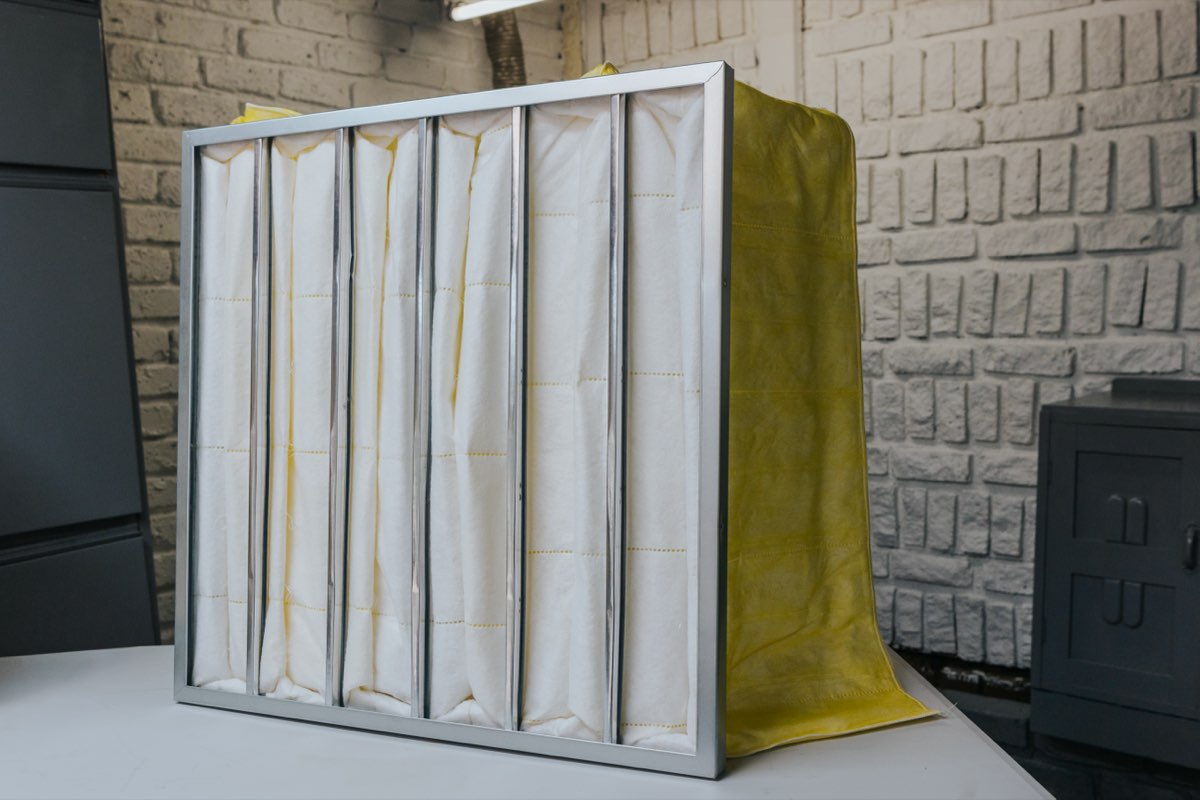
Pocket filters are the default for standard AHU filter sections. The choice within the format is bag depth, and it is a genuine trade-off:
- 595×595×330mm (6 pocket): 225 Pa initial resistance at 3400 m³/h. Fits shallow filter sections.
- 595×595×600mm (6 pocket): 105 Pa initial resistance at the same airflow. More media area means less than half the starting resistance and a correspondingly longer run to the replacement threshold. The cost is 600mm of depth clearance that many AHU sections simply do not have.
If your unit has the depth, the 600mm bag is the better running choice: lower resistance means less fan energy and longer service life. If it does not, the 330mm bag is the honest fit, and you budget for more frequent changes.
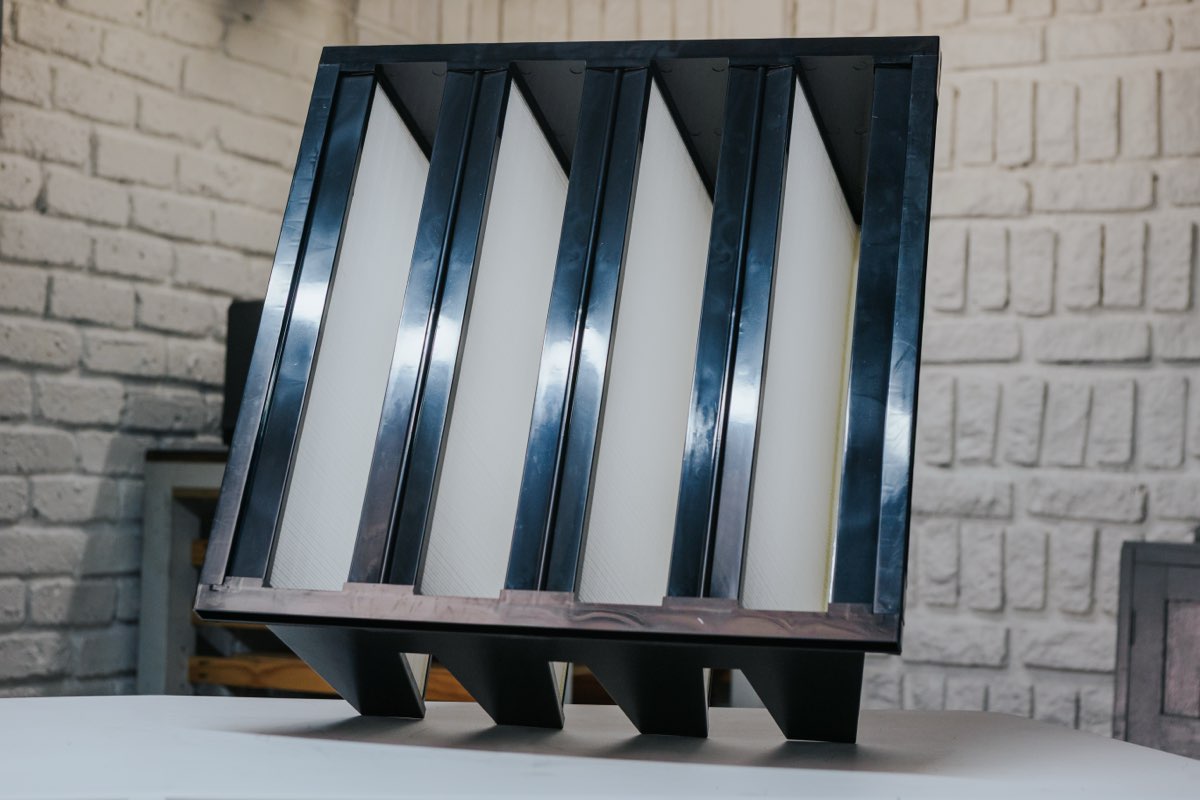
V-bank filters solve the space problem differently. The 592×592×292mm V-bank packs its media into rigid pleated banks, delivering 110 Pa initial resistance at 3400 m³/h in a 292mm-deep frame. That is close to the 600mm pocket’s resistance in half the depth. The rigid construction also holds its shape at higher face velocities where pockets can flutter. The trade-off is unit price: a V-bank costs more than a pocket filter of the same grade.
The energy argument is worth taking seriously at this stage. Filter pressure drop is a significant share of HVAC fan energy, and in most configurations the F9 stage carries the highest resistance in the bank. A lower-resistance format choice here pays back every hour the fan runs.
Specifications: F9 Pocket & Bag Filters · F9 V-Bank Filters.
Stage 3: HEPA Final Filters, When You Need Them
Most comfort-HVAC AHUs stop at F9, and they should. An office, retail, or general commercial building gains nothing from a HEPA stage except a permanently higher fan bill. We would rather tell you that than sell you a filter you do not need.
H14 HEPA final filters belong in controlled environments: pharmaceutical production, cleanrooms classified under ISO 14644, protective isolation rooms, and operating theatres. In those applications the HEPA is the product, and the G4 and F9 stages upstream exist to protect it.
The standard unit is 610×610×292mm, rated at 3400 m³/h with an initial resistance of 290 Pa, manufactured to EN1822 standards. Every HEPA unit, H13 and H14, ships with an individual serial-numbered EN1822 test certificate: the paperwork goes straight into your validation file. Note: per-unit certificates are supplied with HEPA grades only, not with G4 or F9.
Specifications: H14 HEPA Filters.
The Standard Sizes Table
One table for the whole bank. These are the standard sizes we hold in stock at our Silverton warehouse; current prices are published on each product page, and Nick confirms availability same business day on +27 74 159 1634.
| Stage | Grade | Size (mm) | Rated airflow | Initial resistance | Replace at |
|---|---|---|---|---|---|
| 1: Pre-filter | G4 panel | 595×595×48 | 3400 m³/h | 105 Pa | 200–250 Pa |
| 2: Fine | F9 pocket, 6 pocket | 595×595×330 | 3400 m³/h | 225 Pa | 400–450 Pa |
| 2: Fine | F9 pocket, 6 pocket | 595×595×600 | 3400 m³/h | 105 Pa | 400–450 Pa |
| 2: Fine | F9 pocket, 4 pocket | 295×595×330 | 1700 m³/h | 185 Pa | 400–450 Pa |
| 2: Fine | F9 V-bank | 592×592×292 | 3400 m³/h | 110 Pa | 400–450 Pa |
| 2: Fine | F9 V-bank | 592×287×292 | 1700 m³/h | 115 Pa | 400–450 Pa |
| 3: Final | H14 HEPA | 610×610×292 | 3400 m³/h | 290 Pa | 500–600 Pa |
| 3: Final | H14 HEPA | 305×610×292 | 1700 m³/h | 300 Pa | 500–600 Pa |
Half-size formats (the 1700 m³/h units) cover AHU banks built on mixed frame layouts. G4 panels are stocked in nine sizes; the panel filter page lists all of them.
Why the Stages Depend on Each Other
The stages work as a chain: the pre-filter protects the fine filter, and the fine filter protects the HEPA.
A fouled G4 will halve F9 service life. When the pre-filter loads past its replacement threshold, coarse dust starts bypassing and loading the F9 directly, and the F9 reaches its 400 to 450 Pa limit in a fraction of its rated life. The same logic repeats downstream: in a HEPA installation, a neglected F9 stage can cut the H14’s service life in half, and the H14 is by far the most expensive filter in the bank. Our replacement intervals guide covers the monitoring and scheduling detail.
The cost cascade runs one way. Skimping on a G4 panel to stretch the budget costs you an F9 early. Stretching an F9 in a cleanroom costs you an H14 early, plus the validation downtime that goes with a HEPA change. The cheapest maintenance decision in an AHU is almost always changing the pre-filter on time.
There is a fan-energy angle too. Every stage running above its clean resistance adds pressure the fan has to work against, all day, every day. Keeping the bank fresh is an electricity decision as much as an air-quality one.
Ordering the Whole Set
The practical advantage of standard sizes is that one order covers the whole unit: G4 panels, F9 pockets or V-banks, and H14 HEPAs if your application needs them, all from stock in the same despatch.
- Stock: standard sizes held in stock at our Silverton, Pretoria warehouse. Orders before midday despatched same day. Non-standard dimensions are manufactured on a 7 to 10 day lead time.
- Delivery: free nationwide delivery on online orders.
- Budgeting: the replacement cost estimator gives you an annual filter budget per AHU from your stage count and change frequency.
- Sizing check: not sure your bank is running at its rated airflow? The face velocity calculator converts your duct dimensions and airflow into a face velocity you can check against the 2.5 m/s nominal.
If you have the AHU frame dimensions but are not certain of the format, call Nick on +27 74 159 1634 with the measurements and he will confirm availability same day.
Speccing a replacement set? Call Nick Els on +27 74 159 1634 with your AHU frame dimensions, or request a quote. Prebur has supplied filtration to South African industry since 1989.
Frequently Asked Questions
Can I skip the G4 pre-filter and run the F9 alone?
You can, but it is a false economy. Without a pre-filter the F9 carries the coarse dust load it was never designed for and reaches its replacement threshold far sooner. You end up replacing an expensive fine filter on a cheap pre-filter's schedule. The G4 stage exists precisely to prevent that.
What is the difference between G4 and F9 filters?
G4 is a coarse grade: it captures visible dust, fibres, and large particles. F9 is a fine grade, rated at ≥95% efficiency at 0.4µm, capturing PM2.5 and combustion aerosols that pass straight through a G4. They are complements, not alternatives. Our air filter grades explainer covers the full EN779 and EN1822 grade system.
How often does each stage need replacing?
As a Highveld starting point: G4 panels every 6 to 14 weeks, F9 filters every 3 to 9 months, H14 HEPAs every 12 to 24 months. Differential pressure readings override all calendar estimates. The replacement intervals guide gives intervals by region, format, and application.
Are pre-filters washable?
Our G4 panels are not: washing degrades the media and the filter no longer performs to grade. The washable option in our range is the FW7 wire-grid pre-filter: G3 non-woven synthetic media welded onto a galvanised rod frame, 600×300mm. It rinses clean with a hosepipe (no chemicals, no pressure washer) and refits once dry, which suits fresh-air intakes and humid or wash-down plant environments. It is supplied on request: call Nick on +27 74 159 1634 to check availability.
Do I need a HEPA filter in an office AHU?
No. An office or general commercial AHU is well served by a G4 plus F9 combination, and adding a HEPA stage would raise fan energy consumption for no practical air-quality gain. HEPA belongs where the air is classified: cleanrooms, GMP production suites, protective isolation rooms.
What is face velocity, and why does it matter?
Face velocity is the speed of air across the filter face: airflow divided by face area. The standard rating point for full-size filters is 3400 m³/h, roughly 2.5 m/s across the nominal 600mm frame. Run much faster and resistance climbs while efficiency drops; pockets can flutter. Check your bank with the face velocity calculator.
Need help choosing the right filter?
Speak to Nick Els for expert advice on filter selection, cross-referencing, and pricing for your facility.