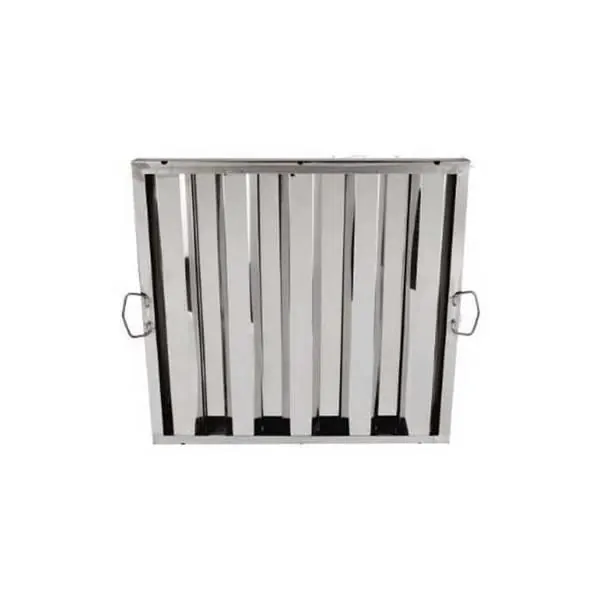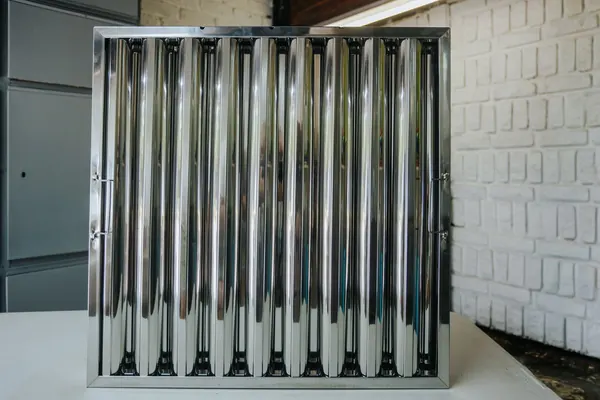
Canopy filter cleaning is a job for the kitchen’s own staff: lift the filters out by their handles, wash them in hot soapy water or a commercial dishwasher, rinse, let them dry and refit them with the UP mark at the top. Do it daily. The steps below are how to clean kitchen canopy filters in a commercial kitchen: the stainless steel baffle filters in a restaurant, hotel or canteen extraction canopy, not the mesh filter in a home cooker hood. For a home hood, follow the appliance manual.
The steps are written for Airtech baffle grease filters. We sell filters and do not clean ducts or certify kitchens, so take fire-safety, insurance and duct-cleaning decisions to your fire-safety contractor, duct-cleaning contractor or insurer.
What the Kitchen Cleans and What a Contractor Cleans
The filters and the drip tray are the kitchen’s routine job. The space behind the filters, the ductwork and the fan are specialist work.
London Fire Brigade’s guidance note on catering kitchen extract systems describes the same split. It also says that no filter is 100% effective, so washing the filters does not replace cleaning the duct.
| Part of the system | Who cleans it | How often |
|---|---|---|
| Baffle filters | Kitchen staff | Daily |
| Drip tray | Kitchen staff | Our suggestion: check it every shift and empty it before it fills |
| Plenum behind the filters | Specialist contractor | Set with your contractor and insurer |
| Ductwork and fan | Specialist contractor | UK benchmark: every 3, 6 or 12 months, by hours of use |
The duct figures come from BESA’s summary of TR19 Grease, the UK benchmark. It gives minimum recommendations of every 3 months for kitchens cooking 12 to 16 hours a day, every 6 months for 6 to 12 hours, and every 12 months for 2 to 6 hours. London Fire Brigade adds that insurers may require more frequent cleaning.
Cleaning the plenum, the ductwork and the fan is a contractor service, and we do not offer it. Ask your contractor, your local fire authority and your insurer what they require of your kitchen.
How a Baffle Filter Catches Grease, and Why It Needs Washing
Air from the cook line turns sharply as it passes between overlapping baffles. Most of the heavier grease droplets do not make the turn: they hit the steel, merge and run down the baffles to the canopy’s drip tray.
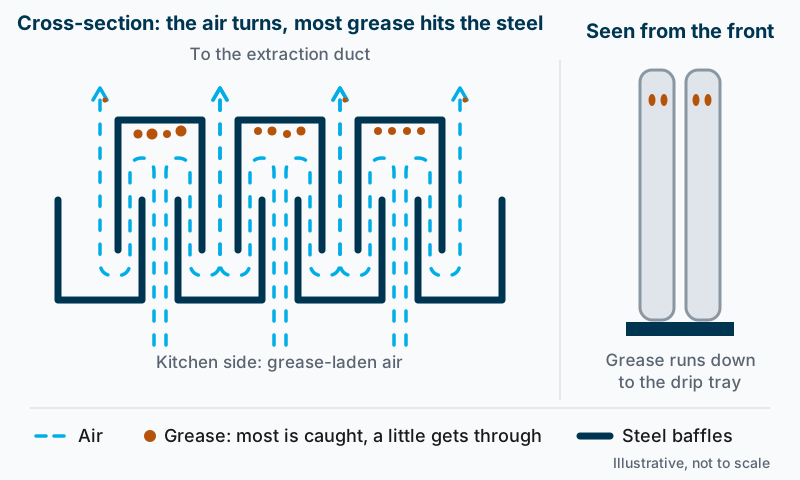
Illustrative and not to scale.
The grease that does not drain stays on the steel, which is why the filter needs washing. Mesh filters behave differently: see our guide to baffle vs mesh grease filters.
How to Clean Canopy Grease Filters: Step by Step
Wash the filters in hot soapy water or a commercial dishwasher, rinse and let them dry. For heavier build-up a kitchen degreaser can be used: follow the label and rinse it off well. Call Nick before using a caustic cleaner.
- Turn off the cooking equipment, isolating its gas or electrical supply as your site procedure requires, and switch off the extraction.
- Wait until the equipment, the oil and the filters are cool.
- Put on gloves that suit the job: sheet-steel filters can have sharp edges, and a greasy filter is slippery. If you use a degreaser, wear the protection its label calls for.
- Empty the drip tray into a closed container for your used-oil collector, not into a sink or drain.
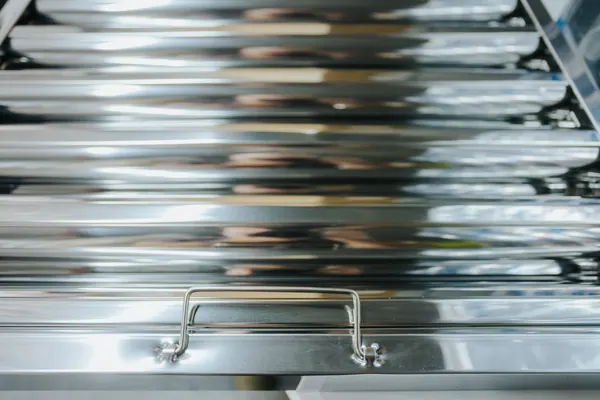
- Lift each filter out by its two wire handles. Do not climb on cooking equipment to reach the canopy: use safe access, or ask your supervisor.
- Carry each filter level or in a tub so it does not drip.
- Wash the filters in hot soapy water at your wash-up sink or wash area, or run them through the commercial dishwasher. For heavier build-up, use a kitchen degreaser at the dilution its label gives.
- Work between the baffles with a soft cloth, sponge or soft brush.
- Rinse well, so that no soap or degreaser is left on the steel.
- Stand the filters to dry.
- While each filter is out, check its baffles and frame for damage or corrosion.
- Refit each filter with the UP mark at the top. Fill every bay and leave no gaps.
Wipe up drips and wash water straight away. The UK’s Health and Safety Executive notes that most slips happen on wet or dirty floors.
Do not run the canopy while the filters are out. UK insurer guidance (RISCAuthority RC68) recommends that a filter-equipped extraction system is not operated with the filters removed.
What Not to Use on Stainless Baffle Filters
- Metal or abrasive scourers: they scratch the bright finish. The Southern Africa Stainless Steel Development Association lists metallic scourers and coarse abrasive powders under “do not use” in its stainless steel cleaning guide. Our own view is that scratches also give grease somewhere to hold.
- Bleach and other chlorine-based cleaners: keep them off the filters, and rinse straight away if they are splashed.
- Flammable solvents: the same UK insurer guidance says they should not be used to clean filters or ductwork.
- Caustic cleaners and oven cleaner: call Nick before using either.
- Two products at once: never mix cleaning products.
How Often to Clean Kitchen Canopy Filters
Clean Airtech baffle grease filters daily, at the end of each day’s cooking. Published UK guidance treats this as the kitchen’s own job: London Fire Brigade says daily or weekly, and BESA says extract hood filters should be cleaned and degreased daily or according to the manufacturer’s instructions.
Your insurer or fire-safety contractor may have their own requirement, so ask them. If the daily clean has slipped, these are the signs.
| What you see | What it may mean | What to do |
|---|---|---|
| Baffles visibly wet with grease at the start of service | The last clean was missed or rushed | Wash them now and get back to the daily clean |
| Drip tray filling fast | Heavy grease load | Empty it more often and wash the filters daily |
| Grease starting to bridge the gaps between baffles | May be a sign the filters are overdue | Wash them now and get back to the daily clean |
| Smoke or heat hanging at the cook line | May be a sign of loaded filters, though it can have other causes | Wash the filters and have the system checked |
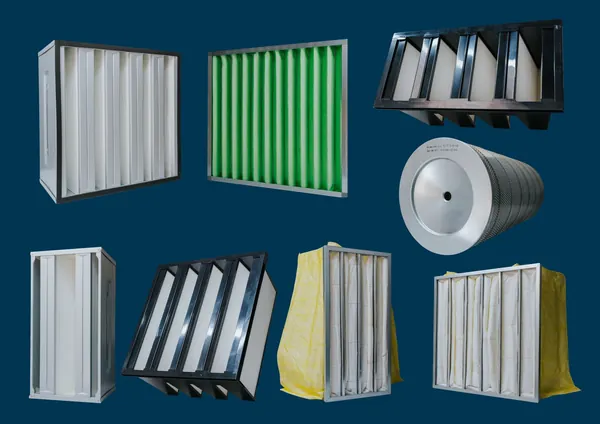
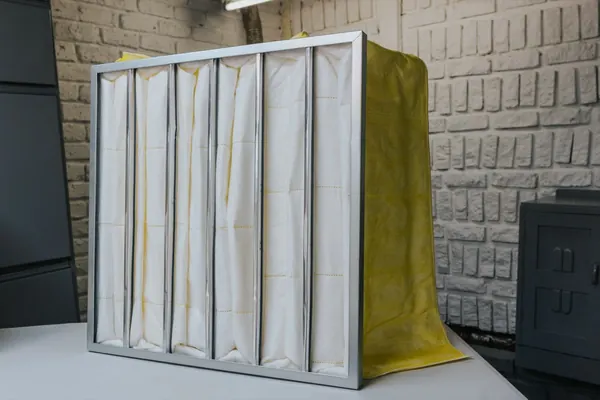
These signs are our own observations, not published criteria. The filters in the building’s air handling units follow different intervals: see our HVAC filter replacement intervals.
Why a Spare Set Makes the Routine Stick
A second set means the canopy is never left with an empty bay. The clean set goes in as the dirty set comes out, and the washed filters can dry before their next turn. The guidance documents do not require a spare set; it is our suggestion.
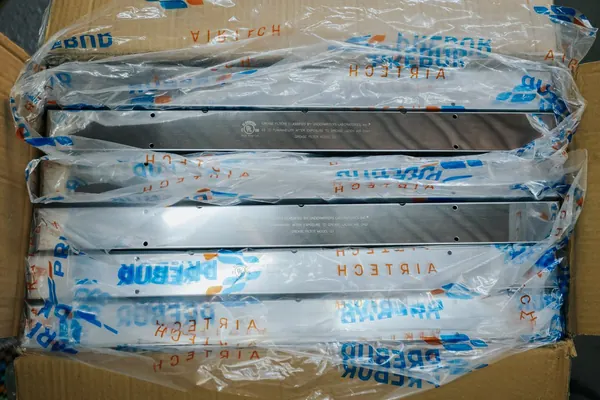
The filters can be ordered from a single unit up to sealed cartons of 6, so a spare set can match your bay count.
When to Replace a Canopy Filter
Replace a filter when it is damaged, because washing does not straighten steel or reverse corrosion.
| Condition | Clean or replace | Why |
|---|---|---|
| Grease film, no damage | Clean | This is normal loading |
| Bent or crushed baffles | Replace | The filter depends on the shape of the air path between the baffles |
| Pitting or rust-through on the baffles or frame | Replace | Corrosion damage does not wash out |
| Frame out of square, or a filter that will not seat in its bay | Replace | Gaps around the frame let air bypass the filter |
We do not put a service life in years on a baffle filter: its condition decides.
Before You Order a Replacement
We stock two sizes, 595×595×48mm and 495×495×48mm. These are the only two sizes we supply.
| Size (W × H × D) | Material | Net weight | Per carton |
|---|---|---|---|
| 595×595×48mm | SS430 stainless steel | 3,05kg | 6 |
| 495×495×48mm | SS430 stainless steel | 2,24kg | 6 |
Measure the face of the existing filter, not the canopy opening. Our baffle filter guide explains how to size a canopy filter.
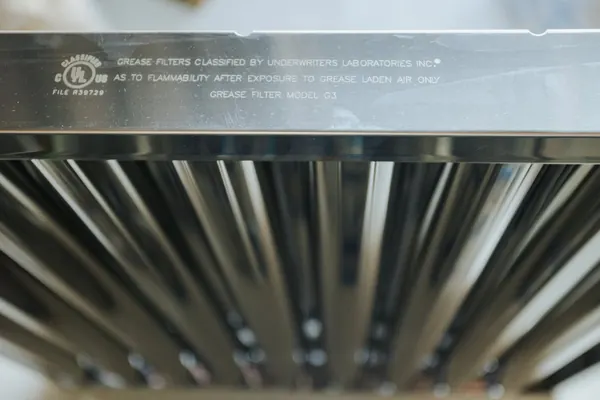
Each stainless steel baffle filter carries the UL Classification Mark (cULus, File R39729): UL Classified to UL 1046 and ULC-S649 as to flammability after exposure to grease-laden air. The mark covers flammability only and says nothing about cleaning methods.
Both sizes are in stock at our Silverton warehouse as part of the Airtech range. We deliver, or you can collect. Current prices are on the product page, with nationwide delivery quoted at checkout.
Replacing canopy filters? Call Nick Els on +27 74 159 1634 or Get a Quote. Sizes and stock: Grease Filters.
Frequently Asked Questions
How do you clean kitchen canopy filters?
Switch off the cooking equipment and the extraction, and let the equipment, the oil and the filters cool. Lift the filters out by their handles, wash them in hot soapy water or a commercial dishwasher, rinse and let them dry. For heavier build-up a kitchen degreaser can be used: follow the label and rinse it off well. Refit each filter with the UP mark at the top and leave no bay empty.
How often should canopy filters be cleaned in a commercial kitchen?
Daily. Wash Airtech baffle grease filters at the end of each day's cooking. That sits at the careful end of published UK guidance: London Fire Brigade says daily or weekly, and BESA says daily or to the manufacturer's instructions. Your insurer or fire-safety contractor may have their own requirement, so ask them.
Can baffle filters go through a commercial dishwasher?
Yes. Airtech baffle grease filters can go through a commercial dishwasher, or be washed by hand in hot soapy water. Follow the dishwasher's own instructions for loading and detergent, and let the filters dry before you refit them.
What should you not use to clean stainless steel baffle filters?
Do not use metal or abrasive scourers, which scratch the bright finish. Keep bleach and other chlorine-based cleaners off the filters, and rinse straight away if they are splashed. UK insurer guidance says flammable solvents should not be used to clean filters. Never mix cleaning products, and call Nick before using a caustic cleaner.
When should a baffle filter be replaced and not cleaned?
Replace it when it is damaged. The signs are bent or crushed baffles, pitting or rust-through on the baffles or frame, and a frame that is out of square or will not seat in its bay. A filter with a grease film and no damage only needs washing. Check each filter every time it comes out.
If the filters are cleaned every week, does the duct still need cleaning?
Yes. London Fire Brigade's guidance says no filter is 100% effective, so some grease reaches the surfaces behind the filters, the ductwork and the fan. Cleaning those is work for a specialist contractor. We sell filters and do not clean ducts, so ask your duct-cleaning contractor and insurer how often your system needs it.
Need help choosing the right filter?
Speak to Nick Els for expert advice on filter selection, cross-referencing, and pricing for your facility.