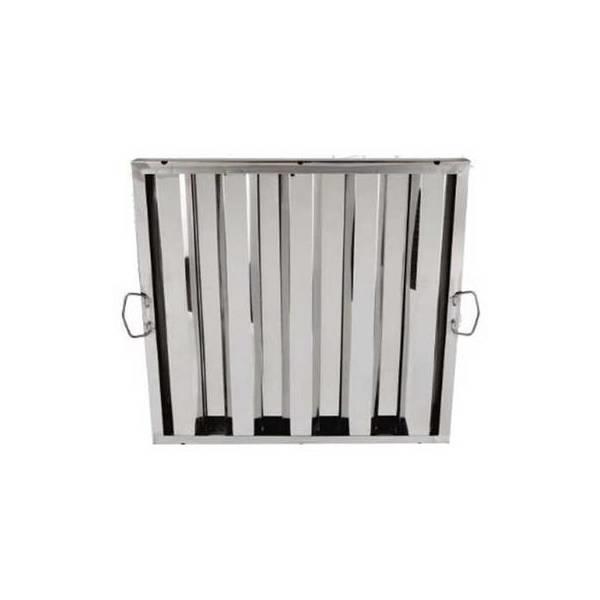
A baffle filter is the grease filter fitted to most commercial kitchen extract canopies. It captures grease-laden vapour by forcing extract air through a series of sharp direction changes: the heavier grease droplets cannot follow the turns, collect on the baffle surfaces, and drain down to a drip tray. The Airtech grease filter range holds two standard canopy sizes in stock in SS430 stainless steel, 595×595×48mm and 495×495×48mm, with other dimensions made to order.
If you are weighing up baffle against mesh, the short answer: baffle filters are the standard specification for grease-laden cooking canopies, and mesh belongs in light-duty or secondary roles. Both the US and UK kitchen ventilation standards take that position, and the reasons come down to grease drainage and flame behaviour.
What a Baffle Filter Does
Two properties of the baffle design matter operationally. Captured grease leaves the filter body instead of sitting in the airflow path, so resistance builds slowly between cleans. And the overlapping baffles present no straight-through path: a flare-up at the cooking surface faces a physical barrier on its route into the duct.
The grease filter product page covers the full mechanism, material specification, and cleaning methods. This post concentrates on what that page does not: the mesh comparison, sizing, and the fire-risk argument for cleaning discipline.
Baffle vs Mesh Grease Filters: What the Standards Say
Mesh grease filters work by impingement. Extract air passes through layers of knitted or expanded metal strands, and grease sticks to the strand surfaces as it touches them. The critical difference from a baffle: the captured grease is retained inside the filter body, directly in the airstream, rather than draining away.
That difference drives the operational behaviour. A clean mesh filter actually offers lower resistance than a clean baffle filter. But as the mesh loads with grease, resistance climbs steeply, extraction performance drops, and the tangled strands are far harder to clean than smooth baffle surfaces. The filter also becomes a grease-saturated element sitting in the path of any flare-up.
The standards bodies reached the same conclusion from the fire side:
- NFPA 96, the US standard for commercial kitchen ventilation, requires grease filters to be listed to UL 1046 and does not permit stand-alone mesh filters. Mesh may only be used as an integral part of a listed hood assembly, or in conjunction with a primary listed filter (NFPA 96).
- DW172, the UK specification for kitchen ventilation published by BESA, states that mesh shall not be the primary grease filter because it provides no barrier to flame. Baffle-style filters should be the primary grease removal device.
To be fair to mesh: it has legitimate uses. As a secondary filter mounted behind a baffle it adds fine-capture capacity, which is exactly the configuration NFPA 96 allows. And in light-duty, low-grease applications such as domestic-style hoods, mesh remains a reasonable choice. What the standards rule out is mesh alone over grease-laden commercial cooking.
Our own baffle filters carry the UL Classification Mark (cULus, File R39729): UL Classified to UL 1046 and ULC-S649 as to flammability after exposure to grease-laden air. That is the grease-filter standard NFPA 96 references, and it is a mark most South African grease filters cannot show.
One scope note. NFPA 96 and DW172 are overseas standards, cited here as context for why baffle designs dominate the trade. They do not define compliance for a South African installation, and this post is not fire-engineering advice: for design or compliance questions on your extract system, speak to your fire consultant or insurer.
How to Size a Canopy Filter
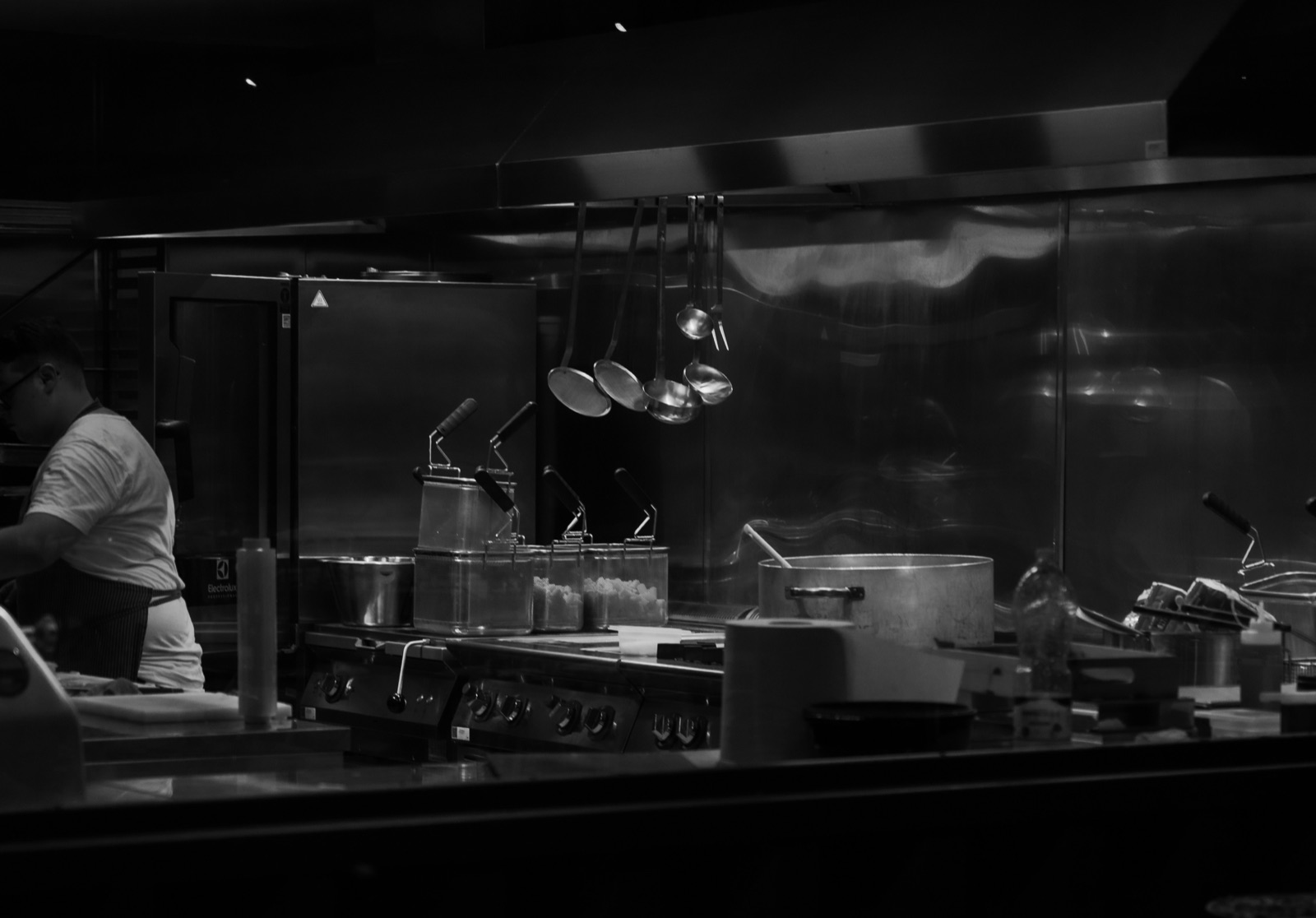
Measure the existing filter, not the canopy aperture. Filters sit in channels or holding frames with working clearance, so a filter ordered to the aperture dimension will not seat. Pull one filter out, measure its face width and height in millimetres, and note the depth: our stocked baffle filters are 48mm deep, and made-to-order sizes run 50mm nominal.
Then count the bays. Most canopies carry a row of identical filters, but mixed sizes in one canopy are common on older installations, so check each bay rather than assuming.
The sizes we supply:
| Size (W × H × D, mm) | Availability |
|---|---|
| 595 × 595 × 48 | In stock, Silverton |
| 495 × 495 × 48 | In stock, Silverton |
| 500 × 500 × 50 | Made to order |
| 500 × 400 × 50 | Made to order |
| 400 × 500 × 50 | Made to order |
| 400 × 400 × 50 | Made to order |
| 500 × 325 × 50 | Made to order |
| 500 × 300 × 50 | Made to order |
| 465 × 395 × 50 | Made to order |
| 345 × 395 × 50 | Made to order |
Note the width-by-height order: a 500 × 400 and a 400 × 500 are different filters, so record the two dimensions in the right order when you measure. The two stocked sizes despatch from Silverton, Pretoria; made-to-order sizes carry their own lead times and pricing, confirmed on quote.
The Cleaning Cycle
For a typical commercial kitchen, clean baffle filters weekly to fortnightly. High-output kitchens, and any operation doing sustained frying or grilling, should clean up to twice weekly. The filters are dishwasher safe and also respond well to a hot degreaser soak, so the labour cost of the cycle is low: rotate a spare set in while the dirty set goes through the wash.
What happens when the cycle slips is predictable. Grease load on the baffles climbs, the drain channels start to bridge over, and resistance across the filter rises. Extraction volume drops, which the kitchen feels as heat and smoke hanging at the cook line. And every week of accumulation adds fuel sitting directly above open burners.
Use each clean as an inspection point. A quick check for deformation, corrosion, and frame damage while the filter is out of the canopy costs nothing and catches problems before they matter.
The Fire-Risk Case for Filter Discipline
The grease that a filter fails to capture, or holds in an overloaded state, is fire fuel. NFPA’s report, Structure Fires in Eating and Drinking Establishments, estimates an average of 7 410 structure fires per year in US eating and drinking establishments, with 61% involving cooking equipment (USFA restaurant fire snapshot).
Grease vapour that passes the filters condenses and hardens inside hoods and ductwork into a combustible layer. A burner flare-up ignites it, and the fire then spreads through concealed ductwork where it is hard to reach and hard to detect. This is why the UK benchmark for kitchen-extract fire-safety cleaning, TR19 Grease from BESA, exists as a standalone specification: grease deposits in extract systems are a recognised fire hazard in their own right.
On the South African side, SANS 10400-T requires grease extraction systems to be maintained clean and serviceable. Clean, drained baffle filters are the first line of that maintenance duty: they capture the bulk of the grease before it enters the duct, and the overlapping design is intended to interrupt the direct flame path from the cook line into the extract system. Filter condition is one factor among several in a fire assessment, and filters are not a complete answer on their own, because a portion of the grease always gets past the filters. The ductwork behind them still needs periodic professional cleaning.
Replacing vs Cleaning
A baffle filter that is cleaned on schedule lasts for years, but it does not last forever. Inspect at every clean and replace when you find any of the following:
- Deformed baffles. Bent or crushed channels change the airflow path, and grease capture depends entirely on that geometry. A deformed filter passes grease straight to the duct.
- Corrosion. Pitting or rust-through on the baffles or frame. Degreaser chemistry and heat eventually take a toll, even on stainless steel.
- Damaged frames. A filter that no longer seats squarely leaves bypass gaps around its edges, and bypassed air carries unfiltered grease.
Our baffle filters are spot-welded SS430 ferritic stainless steel: non-combustible, with a continuous drain channel, in a brushed or mill finish. Full specifications are on the product page. Pricing for this line is confirmed on request: call Nick with your sizes and bay count, and he will confirm availability the same business day.
Need grease filters for your canopy? Call Nick Els on +27 74 159 1634 or Get a Quote. View the full specification: Grease Filters.
Frequently Asked Questions
Baffle or mesh: which do I need?
For a commercial canopy over grease-producing cooking, specify baffle filters. Both NFPA 96 and DW172 treat baffle-style filters as the primary grease removal device, and NFPA 96 does not permit stand-alone mesh filters. Mesh is reasonable as a secondary filter behind a baffle, or in light-duty, low-grease applications.
How often should grease filters be cleaned?
Weekly to fortnightly for a typical commercial kitchen. High-output operations should clean up to twice weekly. If your baffles are visibly wet with grease or the drip tray is filling fast, shorten the interval and set the cycle from the grease load you observe.
Are baffle filters dishwasher safe?
Yes. Our SS430 baffle filters go through a commercial dishwasher or a hot degreaser soak. Running a spare set in rotation keeps the canopy fully filtered while the dirty set is washed.
What standard sizes are available, and can I get a custom size?
We hold two sizes in stock in Silverton: 595 × 595 × 48mm and 495 × 495 × 48mm, both SS430 stainless steel. Other common canopy sizes are made to order, with lead times and pricing confirmed on quote. Measure the face of the existing filter before ordering; the canopy opening is larger than the filter that fits it.
Do baffle filters stop all the grease?
No. Baffle filters capture the bulk of the grease, but a portion of the vapour passes through and condenses in the hood plenum, ductwork, and fan. That residue is combustible, which is why extract ductwork needs periodic professional cleaning regardless of how well the filters are maintained.
How do I order the right size?
Measure one existing filter: width, height, and depth in millimetres, with width first. Count the bays in the canopy and check whether they are all the same size. Then call Nick on +27 74 159 1634 with the dimensions and quantities, and he will confirm availability the same business day.
Need help choosing the right filter?
Speak to Nick Els for expert advice on filter selection, cross-referencing, and pricing for your facility.