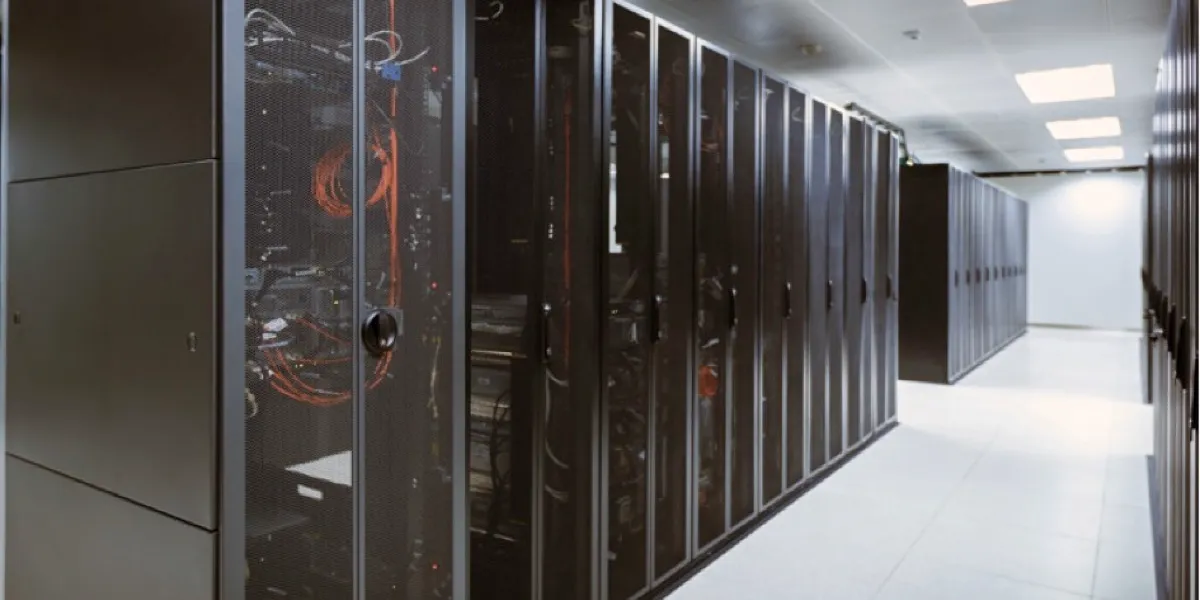
Air Filters for Data Centres: G4, F9 and HEPA From Local Stock in South Africa
Data centre uptime depends on clean air, not just cooling. Dust fouls heat sinks and causes servers to overheat. In the Johannesburg and Pretoria corridor, industrial air pollution adds another risk: gaseous contamination that corrodes circuit boards over time and can void equipment warranties. Different zones in a data centre need different filtration. The server hall, UPS rooms, cooling plant, and fresh air intakes each have their own requirements. We hold G4 pre-filters, F9 pocket and V-Bank filters, and H14 HEPA in stock in Pretoria; other grades, including F7, are manufactured on a 7 to 10 day lead time.
Filtration by Data Centre Zone
Server halls (IT white space): The most important zone to get right. G4 pre-filtration at the AHU inlet, then F7 or F9 secondary. We hold F9 pocket and V-Bank filters in stock, which exceed the F7 recommendation; F7 is available on a 7 to 10 day lead time. Facilities using airside economisers (drawing outside air directly) should specify F9.
UPS rooms and electrical switchgear: G4 pre-filtration with F7 or F9 secondary (F9 held in stock). Battery rooms may also need activated carbon filtration where off-gassing is a concern.
Cooling plant rooms (chillers, CRACs, AHUs): G4 on fresh air intakes, F7 or F9 on supply air. F9 V-Bank filters, held in stock, are a good fit for CRAC and CRAH units where space is tight and energy efficiency matters.
Fresh air intakes: The first line of defence. G4 pre-filters catch the coarse particulate before it reaches any downstream equipment. In high-pollution areas around Johannesburg, this stage works hardest and needs replacing most often.
Critical environments (hyperscale): G4 + F9 + HEPA terminal filtration for facilities targeting the cleanest possible air.
Why Air Quality Matters More in Johannesburg
Most of South Africa's data centre capacity sits in the Johannesburg-Pretoria corridor, which is also one of the country's most polluted industrial zones. Sulphur dioxide from coal-fired power stations and industrial emissions creates a gaseous contamination risk that does not exist in coastal locations like Cape Town.
This matters because gaseous contamination corrodes the copper and silver traces on circuit boards. Major server manufacturers have warranty clauses that require air quality to meet certain standards. If your facility's air quality falls outside those limits, equipment failures may not be covered.
Particulate filtration (G4 + F7/F9) handles the dust. Gaseous contamination requires molecular filtration: activated carbon or permanganate media. If you are operating in an industrial area and are unsure about your gaseous contamination risk, contact us for guidance.
Replacement Intervals
G4 pre-filters: typically every 3 months. Replace when the pressure drop across the filter reaches roughly double the clean reading.
F7 / F9 secondary filters: every 6 to 12 months depending on the dust load.
V-Bank filters: longer service life than pocket filters at the same grade due to the larger media area. Monitor pressure drop rather than replacing on a fixed calendar.
The best approach is pressure-drop monitoring rather than calendar-based replacement.
ASHRAE TC 9.9 Filter Guidance
ASHRAE TC 9.9 recommends baseline particulate filtration (MERV 8, equivalent to EN779 G4) for standard data halls, with enhanced filtration (MERV 11–13, equivalent to EN779 F7–F9) for facilities handling sensitive equipment or located in high-pollution areas.
South African data centre operators in Gauteng typically specify G4 pre-filtration plus F9 secondary as a minimum due to Highveld dust loads. Facilities using airside economisers or located near industrial zones should consider F9 as the baseline secondary stage, with activated carbon added where gaseous contamination is a concern.
Recommended Products
V-Bank Filters
110 Pa initial. Low energy cost. 592×592×292mm.
View → G4 · EN779Panel Filters
AHU pre-filtration. 595×595×48mm.
View → H14 · EN1822HEPA Filters
≥99.995% at MPPS. Individual EN1822 test certificate per unit.
View → F9 · EN779Pocket / Bag Filters
Secondary filtration for server halls with airside economisers.
View →Common Questions
Specifying filters for a SA data centre?
We can confirm ASHRAE-compliant grades and supply from local stock. Call +27 74 159 1634.
Also see: All Industries We Supply · Pharmaceutical Cleanrooms · HVAC Contractors