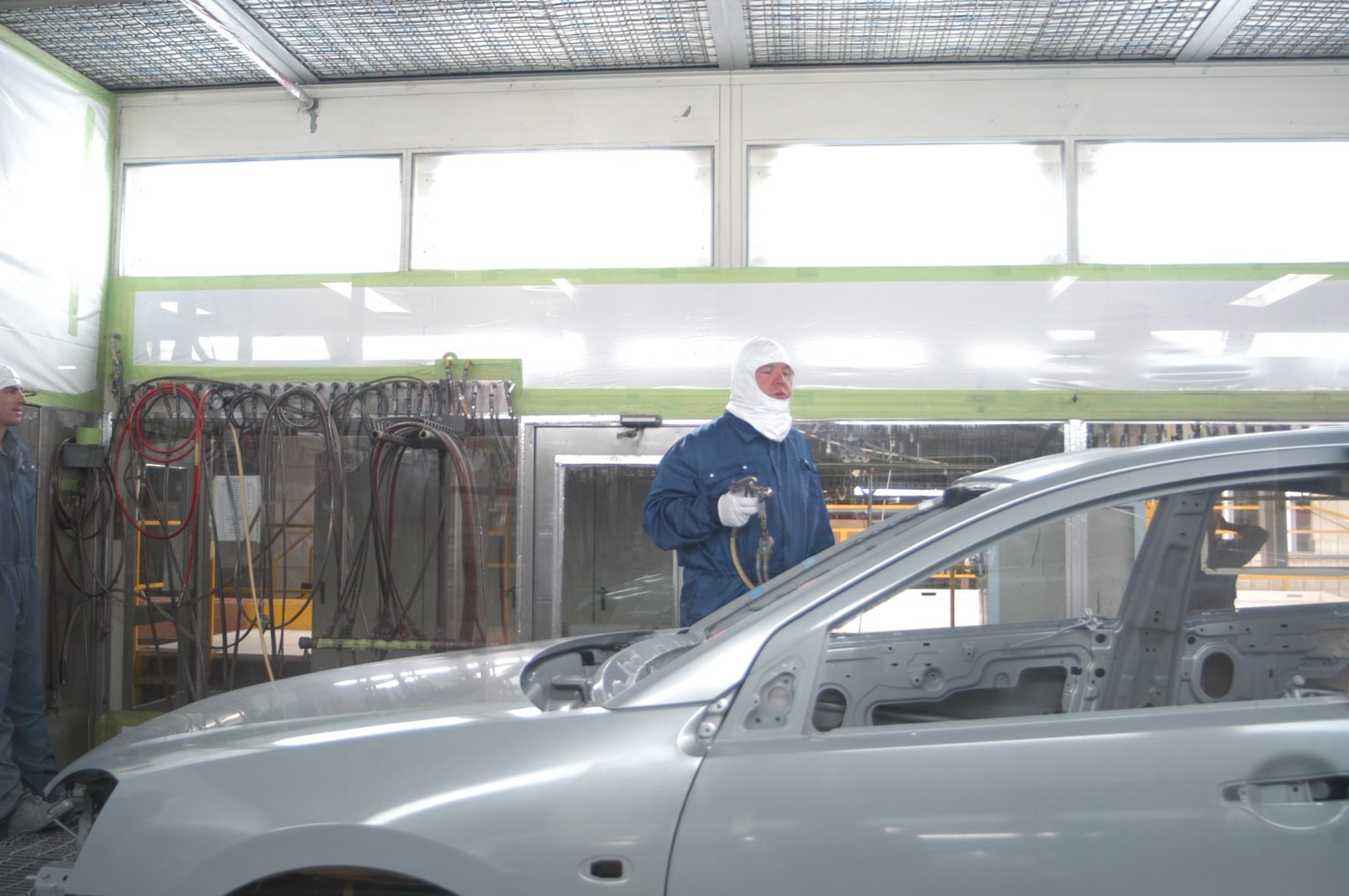
A spray booth has two filter jobs. Intake and ceiling filters clean the air coming in, so dust stays off the wet finish. Floor or exhaust filters, called paint arrestors, catch overspray before the air reaches the fan. Some booths add a final exhaust stage behind the arrestor to protect the fan. The arrestor takes the paint load, so many booths change it more often than the ceiling media. We hold paint arrestor rolls for floor grids and exhaust walls.
Where Each Spray Booth Filter Sits
Where each filter sits depends on the booth layout. In a downdraft booth, air comes through filters in the ceiling and leaves through arrestor media in the floor pit under the grating. In a cross-draft booth, air comes in through filters at the door end and leaves through an exhaust wall at the far end. Semi-downdraft and side-downdraft booths take ceiling air out through exhaust plenums (the air chambers behind the filters) at the rear or side.
| Stage | Job | Typical media | What failure looks like |
|---|---|---|---|
| Intake pre-filter | Removes coarse dust from incoming air | Coarse media, flame-retardant grade to the booth maker’s spec | Ceiling media loading fast |
| Ceiling filter | Keeps fine dust off the wet finish | Fine media over the work area | Dust nibs in the finish |
| Floor / exhaust filter | Catches paint overspray | Paint arrestor (glass fibre) | Overspray hanging in the booth, paint in the duct |
| Final exhaust (optional) | Protects the fan | Pocket filters | Paint on the fan blades |
Intake and Pre-Filters
Downdraft booths often add a coarse pre-filter ahead of the ceiling media, so the finer ceiling filter lasts longer. Intake media sits in the booth’s air path, so use the flame-retardant grade your booth maker specifies. We do not stock booth-rated intake media. For what filter grades such as G3 and G4 mean, see air filter grades explained.
Spray Booth Ceiling Filter
The ceiling filter is a finer media directly over the work. It stops dust settling on paint that has not cured. Arrestor media cannot do this job, and ceiling media cannot do the arrestor’s. We do not stock ceiling media. If you need it, call Nick on +27 74 159 1634 and he will tell you straight whether we can help.
Floor and Spray Booth Exhaust Filter
Exhaust filters, also called paint overspray arrestors, sit in the floor pit of a downdraft booth or across the exhaust wall of a cross-draft booth. Paint the media holds stays out of the fan, the ducting and the stack.
Exhaust media catches paint droplets. Standard arrestor media does not catch solvent vapour, so the fan has to keep moving enough air to carry the solvent out of the booth. The same staged logic applies in air handling units: our AHU filter stages guide covers it for HVAC.
What Paint Arrestor Media Is and How It Works
Glass fibre paint arrestor is a thick mat that gets denser from front to back. This is called progressive density: the fibres are loosely spaced on the face the air hits first and packed tighter toward the clean side. Big droplets lodge in the open front layers, and finer mist is caught deeper in, so paint is held through the full depth of the mat. The same product is also sold as paint stop or floor filter media.
Most glass fibre arrestor has a coloured face and a white face. The usual convention is coloured face (often green) toward the booth, where the overspray arrives, and white face toward the fan. Fitted the other way, the dense layer meets the paint first and blocks well before the mat has held its share. Always check the marking on your roll or your booth maker’s instruction.
Our roll is 2 m wide and 20 m long: 40 m² of media per roll, sold as full rolls. Ask Nick for the data sheet that goes with it.
Glass Fibre Against Other Arrestor Types
Arrestors come as rolls, pre-cut pads, bags, framed panels and folded paper or cardboard panels, in glass fibre, polyester, paper or cardboard.
Glass fibre rolls usually cost less per square metre to buy and cut to any frame. The downside: they generally hold less paint than the alternatives, so you change them more often, and loose fibres make them messier to handle. Folded paper and multi-ply polyester arrestors generally hold more paint and keep airflow steadier as they load, so they last longer between changes, but each pad costs more.
For a booth that sprays all day, ask Nick which option costs less per month on your booth, and whether we can source it.
When to Change Spray Booth Filters
Change exhaust media when the pressure reading tells you to. A manometer is a gauge that shows how hard the fan is pulling air through the filters. Most read in pascals (Pa); older and imported gauges often read in inches of water gauge (1 inch is about 249 Pa) or millimetres of water gauge (1 mm is about 9.8 Pa). Clean media reads low; as paint builds up, the reading climbs. Many booths have one fitted across the exhaust filters.
One method covers most booths:
- Take a clean baseline. Fit new media, run the booth for 15 to 20 minutes and write down the reading. On many booths the gauge reads across the whole exhaust path, not only the media, so this clean reading is your own booth’s starting point.
- Set the change point. If your booth maker gives one, use it. If not, change when the reading has risen above your clean baseline by the media’s working range: the final resistance minus the initial resistance on the data sheet for your roll. Never let the reading climb past your booth maker’s maximum. If you have neither figure, call Nick.
- Change sooner if the booth shows the signs: overspray hanging in the air instead of being pulled away, more dust in the finish, or a fan running flat out.
- Record it. Note the date and the reading at each change. After a few cycles you will know how many spraying days your booth gets from one change.
Media can look usable while it restricts the airflow, so go by the gauge, not by eye. Paint showing on the white face, or in the plenum and duct, means paint is passing through or around the media: either it is overloaded or there is a gap.
Without a gauge, a 2008 US EPA fact sheet on spray booth filters suggests a strict schedule based on how much you spray, and changing ceiling filters at least twice a year. How fast exhaust media loads depends on the paint, the booth, the fan and the painter, so a fixed hour count is a rough guide at best. We recommend the same pressure method for air handling units in our filter replacement intervals guide.
Why Late Changes Cost More
Loaded filters cut the airflow. Dust and overspray circulate inside the booth and settle on the work, which means rework. Solvent vapour clears more slowly, and the fan works harder and wears faster. The EPA fact sheet adds that solvent collecting in a closed space can create flammable conditions.
How to Fit a New Paint Arrestor Roll
Step 1: Make the Booth Safe
Switch off and isolate the booth. The fan must not run while the floor or exhaust wall is open.
Step 2: Wear the Right PPE
Used media carries dried paint and solvent residue. The EPA fact sheet calls for a half-face respirator with organic vapour and dust/mist cartridges, nitrile gloves, coveralls and sleeve protectors when changing it.
New glass fibre irritates skin and eyes too. Glass fibre safety data sheets call for gloves, long sleeves and safety glasses, with a dust mask if fibres are in the air. Read the safety data sheet for the media you use.
Step 3: Remove the Old Media
Bag the old media as it comes out. Do not stack it in the booth. Then clean the grating and frames: remove loose paint and fibre so the new media sits flat.
Step 4: Measure and Cut
Measure the width and length of each row of the floor grid or exhaust frame. Unroll along the row and cut at the end with a sharp blade. If your rows are narrower than 2 m, cut strips along the roll first.
The media is wound tightly on the roll, so give it a few minutes to spring back to full thickness before you judge it.
Step 5: Fit and Seal
Fit it coloured face toward the booth, white face toward the fan, or as marked on the roll.
Close the gaps. Cut slightly oversize and butt or overlap the joins so there is no open seam. Air finds the gaps at the edges and between strips and goes around the media instead of through it, and that paint ends up in the plenum, duct and fan.
Step 6: Take a New Baseline
Start the booth, take the new baseline reading, and write it down with the date.
Coverage Arithmetic
One roll is 2 m × 20 m: 40 m² of media. Add up the filter area of one complete change, then divide.
As an example, a floor pit with filter rows totalling 12 m² uses 12 m² per change. One roll covers 40 ÷ 12 = 3.3 changes on paper, so three full changes, and fewer if your offcuts come to more than 4 m². For that booth, divide the changes per month by three to get rolls per month. Usable offcuts can carry over to the next roll, so treat that as an upper figure.
Disposing of Used Filters
Under South Africa’s Waste Classification and Management Regulations, made under the National Environmental Management: Waste Act (Act 59 of 2008), the business that generates a waste must have it classified. Since the 2024 amendment, classification follows GHS, the globally harmonised system for classifying chemicals. Used paint filters are not on the list of wastes exempt from classification.
Whether your spent media is hazardous depends on what you spray. Until yours is classified, handle it as hazardous: bag it, keep it separate from general waste, and use a waste contractor authorised to handle hazardous waste. Make sure each load travels with a waste manifest (the consignment record); as the generator, completing it is your responsibility. Your paint supplier’s safety data sheets feed the classification. This is general guidance, not legal advice.
Paint-loaded media also burns. Bag it as it comes out and move it the same day to a closed metal bin outside, away from ignition sources. For context only, the United States OSHA spray-finishing rule requires used filter pads and rolls to be moved to a safe, well-detached location or into a water-filled metal container. It is not South African law, but it shows that regulators treat loaded media as a fire risk.
Ordering Media for Your Booth
Measure your bays, work out the area per change, count your changes per month, and order full rolls. Our paint arrestor rolls are in stock at our Silverton warehouse. We deliver, or you can collect. Buy online on the paint arrestor product page, with free nationwide delivery on online orders.
For volume or a booth you are setting up from scratch, Get a Quote. If you are not sure what your booth takes, call Nick Els on +27 74 159 1634 with your booth type and the size of your floor grid or exhaust wall.
Frequently Asked Questions
What is the difference between a paint arrestor and a ceiling filter?
They sit at opposite ends of the airflow. A ceiling filter is a finer media on the air supply of a downdraft booth, and it keeps dust off wet paint. A paint arrestor is a coarse, deep glass fibre mat on the exhaust side, in the floor pit or exhaust wall, and it holds overspray before the air reaches the fan. One cannot do the other's job. We stock paint arrestor rolls; we do not stock ceiling media.
How often should spray booth filters be changed?
Go by the booth's pressure gauge. Take a reading with clean media fitted. If your booth maker gives a change point, use it. If not, change when the reading has risen above that clean baseline by the media's working range, shown on the data sheet for your roll, or sooner if overspray starts hanging in the booth. Without a gauge, a 2008 US EPA fact sheet suggests a strict schedule based on how much you spray: a busy week loads the media faster than a quiet one.
Which side of paint arrestor media faces the spray?
By convention, the coloured face (usually green) faces the booth, where the overspray arrives, and the white face faces the fan. Fitted the other way, the dense layer meets the paint first and blocks well before the mat has held its share. Always check the marking on your roll or your booth maker's instruction.
Can I use HVAC panel filters or synthetic roll media on the booth floor instead?
No. Panel filters and thin synthetic roll media are made to catch dust on the air intake. On the exhaust side, paint coats their face quickly and the booth loses airflow. Use deep paint arrestor media on the floor and exhaust wall, and the flame-retardant intake media your booth maker specifies on the air supply.
Are used spray booth filters hazardous waste?
They may be, depending on the coatings you spray. Under South Africa's Waste Classification and Management Regulations, the business that generates the waste must have it classified, and used paint filters are not on the list of wastes exempt from classification. Handle spent media as hazardous until it has been classified. Classification is your responsibility as the generator; your waste contractor and your paint supplier's safety data sheets can help. This is general guidance, not legal advice.
How much floor area does one roll cover?
One 2 m × 20 m roll is 40 m² of media. Add up the filter area of one complete change across your floor grid or exhaust wall, then divide 40 by that figure. A booth with 12 m² of filter area gets 40 ÷ 12 = 3.3 changes on paper, so three full changes, and fewer if offcuts come to more than 4 m².
Need help choosing the right filter?
Speak to Nick Els for expert advice on filter selection, cross-referencing, and pricing for your facility.